
Introduction
Imagine a map made of strokes, not lines. A map where strokes layer but don’t solidify, divide, or separate. Where place names are verbs and where there is no fixed outer and inner, self and other. A map where places bleed into one another, and possession is collective.
Imagine buildings made entirely of voice and sound. Buildings wherein the dividing lines between individuals and communities are blurred. Walls are replaced with shared sonic textures, boundaries with thresholds and transitions, hard with soft, and privacy with connectivity.
Now imagine that this map and these buildings redraw and rescore a place, an ecology, and a future through sound. Imagine they are sonic architectures or even anarchitectures, where voice and sound, in redrawing architectural and social space, become anarchic. This essay thinks about how individuals and communities use sound and voice in just this way, to imagine new worlds.
Anarchitecture
The origins of the term anarchitecture are difficult to pin down. A portmanteau of anarchy and architecture, the word arrives late. Like many words, it appears long after the practices it attempts to describe. Although the term is most often associated with Gordon Matta-Clark and the Anarchitecture Group in New York during the early 1970s, no single artist or architect can claim ownership of it. After all, to do so would contradict the meaning and spirit of the word itself.
Long before Matta-Clark, people were already imagining and building worlds otherwise. Anarchitecture is already multiple, already uncontainable. It oscillates between architecture and anarchy, building and unbuilding, construction and refusal. If architecture has traditionally described the ordering of space through (some degree of) permanence, enclosure, and authority, anarchitecture describes the many ways that those orders are exceeded and rewritten by inhabitants.
The word anarchitecture evokes horizontal, communally built, indigenous, and anarchist architectures. Informal settlements, open-source planning, self-built homes, and housing cooperatives show us that architecture is never solely designed; it is continually remade through everyday acts of repair, adaptation, and sociality. These traditions of housing, mutual aid, and collective dwelling resist the hierarchies that separate architects from inhabitants, landlords from tenants, councils from communities. They challenge architecture and housing as instruments of property, investment, profit, and state power, understanding dwelling instead as a collective practice. It is within this expanded genealogy that I use the term sonic anarchitecture.
In all the stories in this essay, sound is not passive and controlled by architecture, but active and creative. Voices redraw maps. Songs reimagine monasteries and lives. Pirate radio rebuilds towers with signal. Collective voice connects communities that refuse enclosure and separation. Listening becomes a way of inhabiting the world differently. In this essay, sonic anarchitecture describes the speculative, collective labour through which voice and sound build worlds before those worlds become material. Sonic anarchitecture names these speculative acts of world-making.

Fig 1. Rebecca Lennon, Voice Map of Estate, Queensbury. Dots / Strokes: locations. Lines: connections, Digital Knit (2025). Image courtesy of the artist.
i. Estate Choir
I am in the upstairs bedroom of a terraced house on an estate in Queensbury, North West London. Sitting in the dark, I am waiting for my child to fall asleep. I can hear a train moving past and people arguing. My neighbours are speaking to each other in their front gardens, discussing a film watched a few nights before. In the distance, I can hear the woman who shouts from one of the new-build council maisonettes behind our row and once threatened to come to my garden and kill my dog. Foxes scream and fight, waiting for me to take out their food.
Right outside my window, noise and quiet operate in complex ways. Car engines idle. Dealers are parked up waiting for deals. People smoke outside the boarded-up building opposite our houses. Teenagers gather on the green. One teenager is on the roof looking over us, sitting on a cushion stolen from inside the building. This building used to provide council-funded independent living for adults with disabilities. Now it stands empty and hostile, almost dead, and yet repossessed by new voices and new uses. Its metal boards cover broken windows that have recently been repurposed as microphones for children who shout into them to hear their own echoes. Foxes have reclaimed the space outside it, making dens in the gardens and gathering on the green.
The housing association is finally taking over this boarded-up building that has, for the last four years, hosted and housed mostly gangs, teenagers, foxes, and crows. Behind it is an allotment called Isolation Hospital, named after the Victorian hospital that once stood in its place, treating and quarantining those with infectious diseases. My neighbour, who has an autoimmune disorder, imagines that the sickness never really left; that it seeped into the ground and stayed here, getting into him. Crows sit on the roofs looking over us, occasionally swooping down to steal eggs left for the foxes.
When I moved here eight years ago, I began to imagine the estate’s soundscapes as a map; one that was continually redrawing and rescoring it from within. Houses and flats are housing association, council-owned, ex-council, privately owned and shared ownership. There are terraces, maisonettes, low-rise and mid-rise blocks, all built at different times to different political visions. Homes are built cheaply and packed tightly together, amplifying sound as it passes through walls and bodies alike.
Voices and sounds that move around the estate are haunted by its past, shaped by its materiality, its neglect, its histories of toxicity, violence, and architectural failure. As Mark Fisher writes, the very etymology of a haunt always suggests a house.1 Perhaps that’s why estates remember so loudly. The politics of an estate speaks as soon as one walks into it. It tells you who belongs and who doesn’t. It tells you its story through its walls.
Yet even in moments of sonic and social dissonance, there is always resistance to architecture. There is always another way of making space. As Katherine McKittrick reminds us, space is never simply inherited but constantly produced through the relations that unfold inside and through it.2 In this sense, the estate is not fixed, it is remade every day.
And as I lie in this dark room, my child snoring next to me, I can hear my neighbours singing. I begin to sing too. We follow one another through the walls and across houses, responding in shifting patterns of call and response. We move between connection and disconnection, harmony and dissonance. My dog barks and my neighbour sings her name. Another neighbour changes pitch and we all follow. At times, the choir sounds demonic; at other times grating; and at other times, unexpectedly beautiful. Every voice occupies its own place, like an ecosystem, or a symphony. Voices are coming from all around the estate. There are no words, just voices ebbing and flowing, drawing lines between different houses, buildings, and access routes, sensuously reconnecting the estate. There is alignment and disagreement. My next-door neighbour and I stopped speaking for three months over a political difference, yet we are close again now.
And now I am leaving. The boarded-up building will be redeveloped. The foxes will move on. The gangs will relocate. The Isolation Hospital allotment will eventually be built over. The housing association will sanitise the estate. A new design will replace the old. But the echoes of voices will remain. They will linger in dissonant solidarity, like the archetypal stories of those who haunt their houses after death, possessing their homely possessions, and refusing to let go.
Afterall, buildings can partition homes, separate bodies, and divide communities, but voices are fugitive; they will always build worlds that power cannot contain.
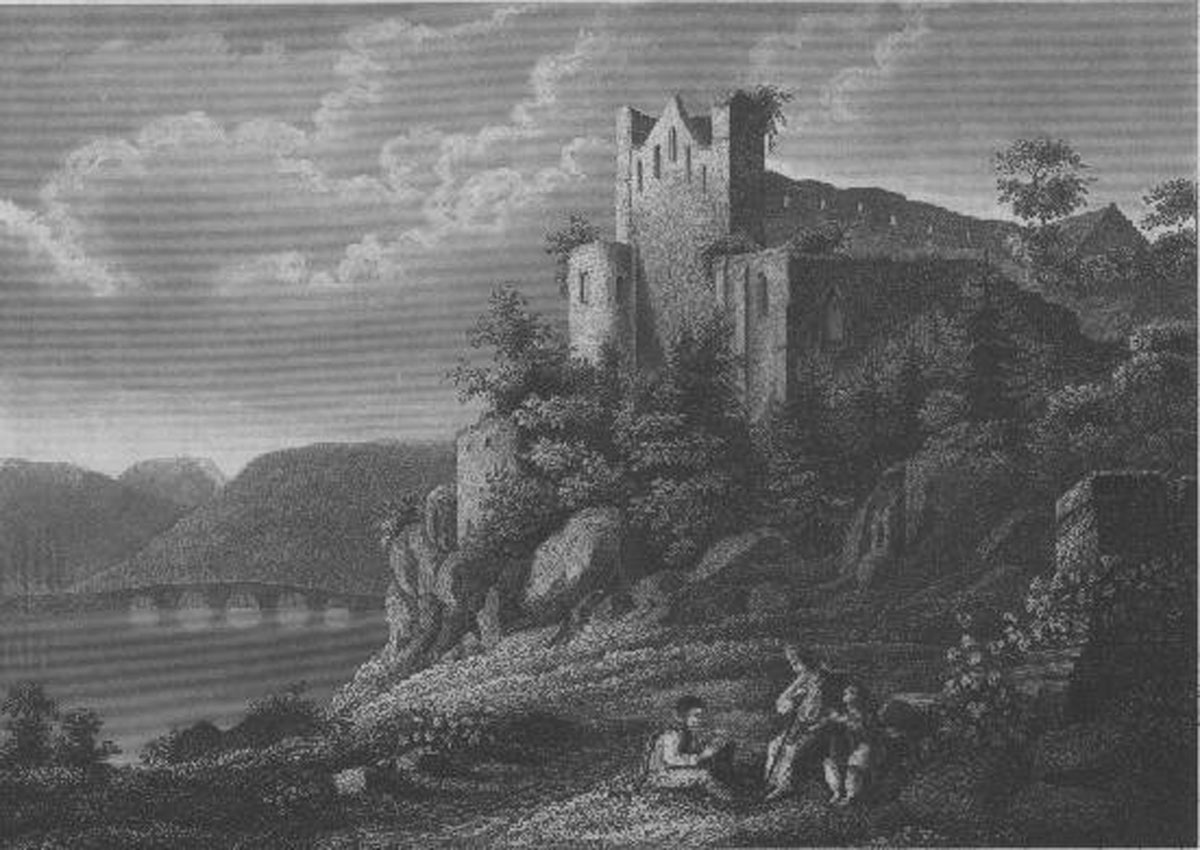
Fig 2. Carl Reiss, St. Rupertus Kloster bei Bingen (Ruins of Rupertsberg Monastery) (c. 1840). Steel engraving, published by the Bibliographisches Institut. Image via PICRYL Public Domain Repository. Public Domain.
ii. Rupertsberg
The soul is symphonic and by nature it has voice (von Bingen, 12th century)3
In 1146, Hildegard von Bingen was sitting by the window of her convent in Disibodenberg Abbey, a Romanesque Benedictine monastery in what is now southwest Germany. The building stood remote and secluded atop a high, forested hill, distantly overlooking the world from above, and pivoting over and between two rivers. Any occasional visitors to the monastery could be watched for miles, as faint, slow-moving dots traced across water and land toward the Abbey. The convent had a stagnant, musty air, and its slowness felt anxious. Its walls were thick, textured stone with curved arches and small windows and there was a long nave for communal chanting. The nuns’ quarters were small, walled-in, and sealed off from the rest of the monastery, which belonged to the Abbot and his monks.
Hildegard listened closely to the nuns’ voices politely moving around the monastery: their feet shuffling, their hands fidgeting, their whispers in dark corridors. She imagined what it would sound like if the nuns were the monastery.
For Hildegard, sound was not external to the body but part of it. Voice passes through us and connects us to others. Voice and breath are extensions of the soul. Silence, she thought, was unnatural, akin to violence, and always imposed from the outside. In a letter to monastic authorities Hildegard wrote, ‘Those who impose silence… do grave injury’.4 And Disibodenberg did just that.
The monastery was, she thought, a quiet acoustics of oppression; a surveillance system that allowed only sounds approved by the male authority. The nuns were subject to strict obedience, enclosure, and regulation. The monastery controlled when, how, and where the nuns sang, how they spoke, and where they moved. They controlled volume, tone, and pitch. Discipline was enforced sonically, through bells, chant, and stone. The rhythm of the bells came eight times daily, dictating the structure of monastic life. Space was tight. Hildegard complained that the nuns’ quarters were too small for them. It was becoming claustrophobic.
For the nuns, spirituality was the only part of their lives that gave them space. And the main instrument for this spirituality was the voice. Voices came from inside their bodies, and extended beyond them, connecting them to each other, and, they thought, to God. They experienced these acts of voicing as boundless, transcending the physical limitations of their quarters in the monastery and moving them out of their constraints. With voice the nuns collectively reorganised themselves. And despite the monastic authority’s control, their voices had become a speculative sonic anarchitecture, helping them to reimagine the building and their lives. Afterall, the authority controlled many things, but it couldn’t control voice.
When Hildegard imagined what it would sound like if the nuns were the building, she imagined this new building: sonic, vocal, boundless, and collective. A place where the nuns had space, where they were no longer confined and regulated and where the rhythms of discipline didn’t apply. In the future, this sonic anarchitecture could even become material: their voices could build a new world.
Initially, the new speculative monastery was built only of voice. Its layered harmonies, chants and spatialised vocal textures were built in dedicated daily practice, with urgency, joy, and release. ‘I heard a sound like the voice of a multitude’ Hildegard wrote in Scivias, her book of divine visions.5 And she began translating voices into space, light, and stone. Architecture, she thought, was a material expression of the order of the world. With her sisters’ voices, she could restore the order.
And so, in 1147 Hildegard began designing a new, independent, female-only monastery for her nuns. Named Rupertsberg, the building was the opposite of their former home. It was large, light, and connected, situated at the junction of the Nahe and the Rhine rivers, the latter a major travel and trade route, making the monastery visible to every passing ship. Visitors would be common. The slowness would go. Pipes would bring running water to the nuns’ rooms, a luxury not afforded to them at Disibodenberg.
Most significantly different, though, would be the sound of the place. There would be no whispers, no silence, no sonic discipline. The nuns could speak freely. They would even move differently, choosing where they went, how they sang, and how they connected with each other. The spiritual interior world they found in collective voicing and music would be allowed to spill outward into the whole building.
Shortly after, Hildegard began formally composing the speculative sonic anarchitecture that the nuns had been building with their voices for some time. The sisters were still living in Disibodenberg at this time, but they could finally see their future outside it. The epic musical composition was named Ordo Virtutum (The Order of the Virtues). It was a morality play and sacred music drama, wherein collective female harmonies built a complex musical and anarchitectural world with only voice and chant, occasionally interrupted by a lone male staccato dissonance.
In Ordo Virtutum, characters and acts are developed musically through tone, pitch, and melody. The female Virtues sing together, while the male Devil acts alone and does not sing at all, but shouts, excluded from melody. Sonic female collective participation determines spatial and spiritual belonging. Voice organises the world.
Ordo Virtutum was, of course, a strong critique of the church. But it was also a clear reflection on the voices of Disibodenberg. In the play, spatialised female voices harmonise and converge, climbing and winding vertically up towers through a steady build in pitch. They then move horizontally along corridors through a dense, flat layering of shifting, gathering chants. Voices seem to move freely, pushing themselves further and further out of the confines of the musical and architectural structure.
In the year, months and days before their departure, the nuns came together through chant to develop and finalise Ordo Virtutum, voicing themselves out of Disibodenberg and towards a new future. They relocated to Rupertsberg in 1150, rehearsing and performing their new sonic world inside the new monastery, while construction was still underway. It felt symbolic to Hildegard that as voices built sonic anarchitecture, dissonant sounds of stone cutting and hammering were in the background.
By 1151, Ordo Virtutum was complete, and Rupertsberg had begun to find its rhythm. The sisters finally had space. Hildegard listened to their voices as they moved around the monastery. Their voices were audible across all corners of the building. Footsteps were hard and less anxious. She could hear humming, singing, coughing, laughing, talking, and serious discussion. Sounds splintered and layered but felt viscerally connected. There were variations of tone, pitch, and melody that she hadn’t heard before. It was ‘the voice of a multitude’.6
The sound of the nuns filled the monastery. From then on, the nuns were the monastery.
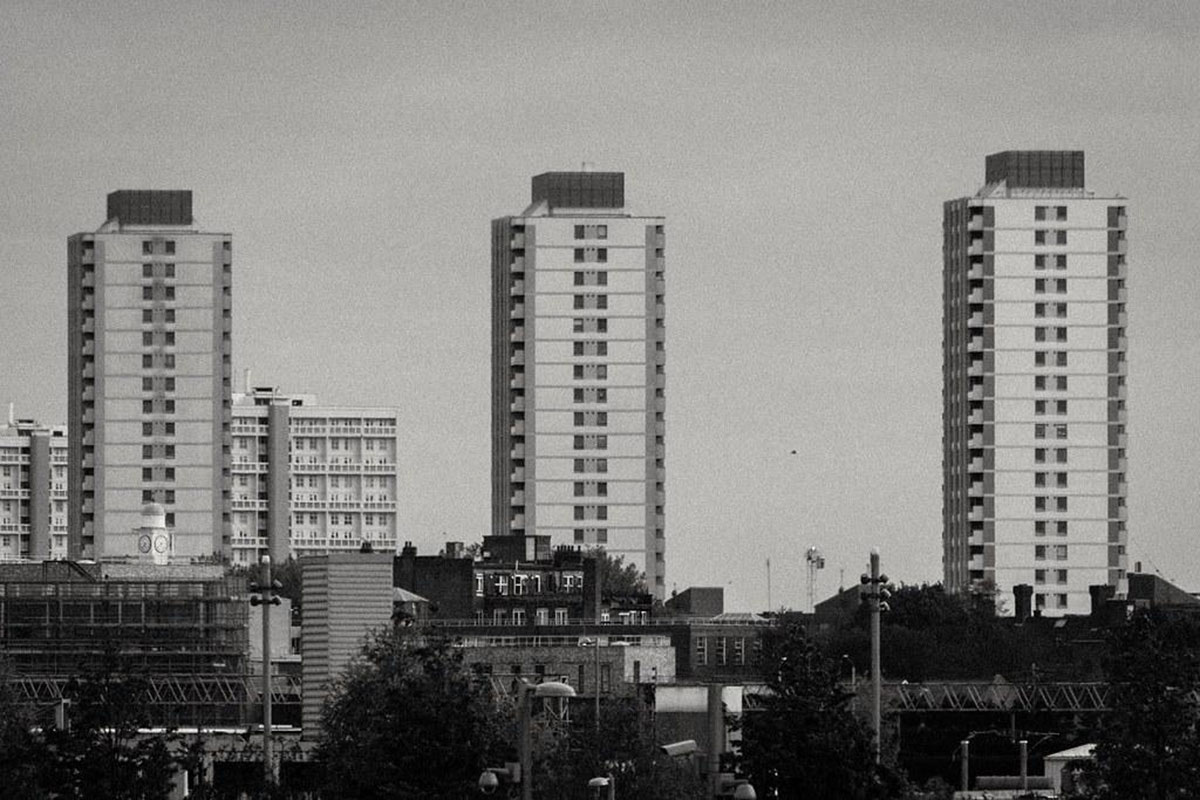
Fig 3. Gary Kinsman, Crossways Estate, Bow, London. (2005) Photograph. via Architectuul. Licensed under CC BY-SA 4.0.
iii. The Crossways Towers7
A man is sitting on the roof of a high-rise tower block in the middle of the night. The tower is one of three in a row standing tall and symmetrical in a built-up area of Bow, outer East London. From this height, the man can see everything, a sprawling geometric pattern of mid and low-rise flats, new builds, and terrace rows. In the distance, two more tower blocks are looking back at him. It’s loud; a thick sonic sludge of electrical hums, traffic and wind are hitting against his face. The two other towers probably have people on the roofs too. He is with them, talking to them.
It’s dark. He can see lights over the city for miles, but he can’t see his hands or exactly what he is doing. He can feel the roof though, and he can smell it. His palms and fingernails are pressing into the dirt. He loves the smell of the roof; it isn’t like any other smell. He looks around and visualises the connections between flats, houses, lives, voices. It’s a network of fuzzy signal extending further and further out of the area. They couldn’t do it without the height of the towers. This tower block is the perfect transmission device.
He climbs into the concrete hatch of the top floor. In his hands he has the rig: a heavy, taped-up metal box fitted with a cooling fan from an old PC. Cable is looped around his arm tightly. He finds the lighting circuit, wires it into a choc block to power the transformer, and tapes it down with gaffer. The transmitter is live.
He steps back out onto the roof. His eyes have got used to the dark now. He can do the whole operation inside 5 minutes, a big improvement from when he first started and he would be up there for hours. He pulls out the aerial made from two lengths of plumbing pipe pushed into a plastic T-piece, a cable fed directly into the pipe, and everything held together with glue that smells of vinegar. He gets up, slots the plastic base onto a wooden broom handle, and fixes it to the railing. He’s right at the edge of the roof now, looking down. He adjusts the angle, so it stands perfectly vertical and clamps the wood secure with a bike lock. Finally, he unwinds the cable from his arm and runs it from the transmitter down to the rig.
There’s a vibration. Below, someone is speaking into the signal. He leans over and listens, holding his headphones and squinting to focus the sound. Someone somewhere is shouting in the sludge, but he can just about tune into the muffled voice speaking to him through static from the studio below. A window closes and the signal catches. He crosses the roof and climbs down the ladder. The sound of the roof gets sucked away by the closing hatch. He’s shaking, exhilarated. The roof is always the best part of it for him. The moment when he connects and draws a map of pirate signal over the city.
Built in 1970, the Crossways were named after three historical railway engineers: Hackworth, Mallard, and Priestman. The towers were higher than many others in the area, rising 25 storeys above a train station and major road. They were visually messy; their verticality intersecting with horizontal lines of movement and connectivity, train tracks, roads, bridges, and signal systems, from every angle. The three flats as they were known locally were also connected to each other by rigid, high-level walkways, and access bridges.
The Crossways weren’t unique. They were designed according to a standardised high-rise template of high-density social housing with a small footprint. Other towers were built to the same template across East London, and they also had people on the roofs. Across these towers, pirate frequencies competed and influenced each other. The man learnt his craft from looking at other rigs on other roofs, and they were learning from him. Occasionally, a new method would pop up, and in what seemed like seconds they had all adapted it. The skyline was a technical manual; a distributed knowledge system of people on roofs, moving through inaccessible parts of buildings, taking over flats and repurposing towers across the city.
On top of its height, neglect helped the success of the Crossways too. The towers were known for overcrowded flats, poor repair, and a lack of regeneration, and, after this, gangs and anti-social behaviour. This meant that people moved out, and others were reluctant to move in. As a result, the estate had high vacancy levels. By the 1990’s a significant number of flats were either vacant or used as temporary accommodation. These empty flats could now become studios and relay stations. The holes in the housing system created openings for pirate signal networks.
The man knew the buildings intimately, they all did. No one knew the Crossways like they did: not the architects, not the planners, not even the residents. They knew the routes, the smells, the sounds, the electrics. They knew the hatch locations, the working meters, the unlocked cupboards and doors. They had maps of all the vacant rooms and flats for broadcasting inside. They knew which tower carried signal furthest in wind and rain, which side of the building moved signal towards Stratford, and which side died over Mile End. They also had live geographic signal data. Listeners driving around London would call in to confirm how far the signal was reaching, to then be rewarded with a shout out.
The towers had taken on other resonances too. The police and broadcast authorities had shut the network down three times already, declaring the transmissions illegal and the music violent. It was the height of the towers that terrified the authorities. From the Crossways, the signal had reach. It also had perspective. The punishment was of course, spatial. The man was given an Anti-Social Behaviour Order (ASBO) prohibiting him from going higher than the fourth floor of any high-rise building.
But for them, it wasn’t just about height, transmission and reach but return and speed, a compulsive rhythm. The networks used DIY rigs that could be rebuilt quickly and cheaply if seized and they knew exactly how to get the signal back up as quickly as possible. They knew where they could be seen and how quick they had to be, to be unseen. The roof was a routine. If the aerial came down, it went back up. If a station disappeared, another appeared somewhere else. The success of a tower was measured by how quickly a signal could return to it, and how easily they could evade the authorities. They were flexible and nomadic. Transmitters moved. Roofs moved. Studios moved. Aerials moved. The locations of studios were kept secret; you had to have multiple trusted references just to be allowed through the door. They put rigs on multiple tower blocks to create decoy transmitters, confusing the authorities and exhausting their resources. The network was strong, and resilient. They knew they were creating something important, something historical.
Even after his ASBO, the man wasn’t going to stop. None of them were. There were aerials on towers all over the city. In the Crossways, they were closed in. Flats were small. Movement was tight. Lives were restricted. The signal was a way of leaving your building and pushing its limits. They redrew the towers to give themselves space.
In the end, the pirate signal had built new towers and new networks, reconnecting voices across the city.
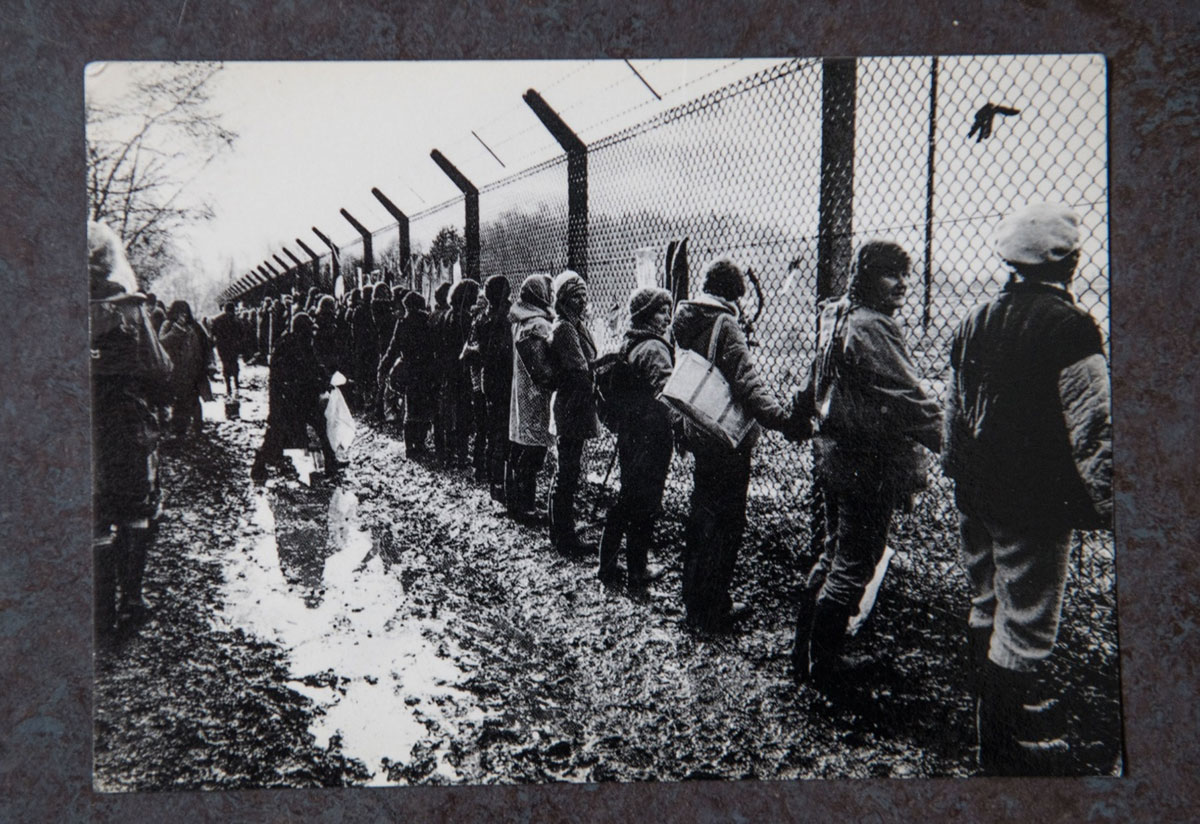
Fig 4. Demonstrators facing the base and linking hands around the nine-mile perimeter fence during the Embrace the Base action (December 1982). Image courtesy of the Greenham Women Everywhere Heritage Archive. Licensed under CC BY-NC-SA.
iv. Greenham: The Fence, the Wall, and the Commons
The fence was 9 miles long and 8 ft high, made of gnarly steel mesh with concrete posts and a barbed wire top that folded inwards at an angle to prevent intruders getting in. The fence protected a vast military base which would later hold 96 nuclear cruise missiles, a runway, planes, offices, military personnel and beyond that, an expanse of empty space like a no man’s land.
Before its repurposing as an airbase, Greenham Common was heathland; full of lilac heather, gorse, ground nesting birds, and birch. Heather was once a multi-use plant, used to thatch roofs and build shelters. It was woven into bedding and rope. It fuelled fires, and flavoured ale and honey. It was thought to bring fertility and prosperity and was used in rituals to help the land thrive. In 1941, the heather was dug up and the commons emptied out. By the 1970s, Greenham was under foreign control and part of a global war effort. The land became private and patrolled, disconnected from the people and habitats that once knew it intimately.
A low-frequency sharp hum of military equipment, another force of passive violence, kept the birds out and acted like a sonic mirror of the steel mesh fence. The missiles were a complex paradox too. Described as theatre weapons, they were designed by Nato and the US military as a symbolic, tactical, and political deterrent against the Soviet Union during the Cold War. They were declared a safety measure only, a last resort response in the event of nuclear war, and as such, were never actually used in active warfare. Yet from 1983 these 96 humming, vibrating, metal objects sat waiting, charged with the potential for remote, long-distance mass destruction across continents, and caught in a tense limbo between stillness, bureaucracy and unimaginable violence.
After all, the 96 weapons carried thermonuclear warheads ten times more powerful than the one dropped on Hiroshima. Blast waves could take down buildings; fires could disappear whole districts, and radioactive particles could move into soil, rivers, forests, fields, bodies, and ecosystems, remaining there for years, even decades. Wind could carry contamination across borders, fences, maps, and military lines, uncaring of the political, animal, human, or land structures that they touched, and indifferent to ownership, alliance or identity. Greenham was anarchitectural in a whole different way than the pirate signals of the Crossways or the vocal monastery at Rupertsberg. This US military nuclear base in rural England teetered at the edge of major catastrophic global unbuilding, and yet without any possibility for rebuilding within or after the event.
Thousands of soldiers and military workers, mostly men, moved slowly around the base, carrying out their daily tasks in security, engineering, missile maintenance, communications, transport, cleaning, cooking, and administration. Work was repetitive, technical, and often mundane; codes, patrols, and site upkeep were their ordinary routines, their bread and butter. They maintained vehicles, systems, generators, radar equipment, patrols, the site, the people, and the missiles themselves. Around half of the staff were low-paid service workers. The rest were slightly higher on the pay scale with only a small amount of military personnel at the top. Women represented around ten percent of the military workforce at Greenham. And most were local women from Berkshire who were right at the bottom of this pay scale, with local men just slightly above them.
The workers weren’t responsible for the weapons, no one was. Each worker was a cog in a much bigger machine. Even those at the top of the labour hierarchy at Greenham couldn’t have made the decision to launch a missile. This could only have happened as a complex culmination of procedural actions distributed across a global military and political hierarchy. Instead, at Greenham, the potential for violence was remote, distant, and bureaucratic. The threat of the weapons felt impersonal and to some, even convenient. After all, even if a missile were launched, it would be so far removed from the lives of those who launched it that it would feel abstract. And of course, they thought, it would be absolutely necessary.
In 1982, this remote and abstract violence was met with its opposite: the nearness of touching bodies. 30,000 female protestors were holding hands in a chain around the fence. They were singing; their palms facing the steel mesh; their breath, voice and song moving against the wire.8 This protest was pre-emptive, aimed at keeping the weapons out. Voice filled the space that would later be occupied by metal.
The women were the opposite of the military camp in other ways too. They inverted the concept of theatre weapons, making non-violence emphatic, over-the-top, and theatrical. They would go ‘limp’ when they were arrested and carried off by police. They sang when faced with soldiers carrying guns and using force against them. They played with, subverted and even reclaimed the male stereotypes of their image as women, putting teddy bears and baby clothes on the fence to express their status as mothers, and focusing the protest on the futures of their children.
They evoked vulnerability and softness as a tactical weapon. Yet it was with this symbolic vulnerability that, in 1983, when the first missiles were flown in, they cut and broke the fence, resisted the police, threw quilts and duvets over the wire, and entered the base to dance on the silos. Hard and soft, voice and metal were in constant conflict. An activist was nicknamed Metal Mickey by police (after the 1980s TV robot) when she smeared herself in mud, wearing a low-slung belt full of bolt cutters, and argued that metal itself, of the fence, the wire, and the weapons, was an extension of the patriarchy. She was mocked publicly but in reality, many of the protestors shared this view, and the cutting and breaking of the fence became symbolically charged. The protestors were dismissed as radical, mad women. Margeret Thatcher called them eccentric. But the group continued, knowing that they had to.
Numbers had grown. There were now 50,000 women facing the circular perimeter fence, singing. In a protest called ‘Reflect the Base’, they held up mirrors, forcing the base to see itself, refusing its abstraction and demanding that the workers inside it take accountability for their part. Living in soft tents, protestors arranged themselves into colour-coordinated gates, each with a different community focus. The red and green gates were the child-friendly ones, while the green also became a hub for lesbian, trans, and non-binary protestors. They built crèches, outdoor schools, and alternative families. For many in the queer community, Greenham’s openness became an escape from the discrimination they experienced outside. The yellow gate was for black and intersectional feminists, instigated by members of the Black women for wages for housework group. There was even a party gate for young protestors who turned their gate into a festival.
Yet, while the peace camp had many creative and political strategies, voice was their primary weapon. A Swedish research project titled ‘Kroppens Partitur (The Body’s Musical Score)’, led by neuroscientist Bjorn Vickhoff, found that communal singing in choirs regulates heartbeats so that the pulse of choir members tends to increase and decrease in unison, building group solidarity through embodied alignment and the synchronised movements of breath. 9 At Greenham Common Peace Camp, this embodied vocal alignment became a force of resistance. Voices were everywhere. Vocal alignment was physiological and political and practical. Protestors were the ‘voice of a multitude’.10 They were harmonious and dissonant, expressive and cathartic.
Voice and song were used by protestors to subvert the rhythm and tempo of the authorities: ‘If the police brought in horses or slapped their thighs to create a rhythm before charging, we would sing something slow and lyrical like ‘you can’t kill the spirit.’11
Song also helped to keep momentum; reminding them of their motivations, resharing instructions and maintaining group timing during coordinated actions. During an action at the camp in 1983, protestors cut 4 of the 9 miles of the perimeter fence and forced it down while singing. Song enabled them to cut the fence simultaneously and rhythmically: call and response shared the instruction ‘Snip, snip, snip’ across 4 miles of fence and thousands of bodies.12 It was a rhythmic and percussive act of creative destruction. The fence fell and protestors entered the base. There were evictions, arrests, and imprisonment.
In another very different act of call and response, the camp moved their protest to Parliament Square, outside the Houses of Parliament in London. As US President Ronald Reagan arrived to address Parliament in 1982, the women staged a ‘Keening Action’ outside. Wearing black funeral clothing, they performed a collective act of ritual mourning for the lives of future children lost to nuclear war. The protest reinterpreted an ancient Gaelic tradition of vocalised lamentation for the dead, filling the square with dissonant vocal sound, improvised guttural wailing, weeping, moaning, and chanting. As loudspeakers were prohibited in the square, amplification relied on collective vocal alignment alone. And as they keened, the women’s voices were mobilised to move symbolically and sonically from the square to the Houses of Parliament, penetrating its walls and forcing their voices onto public record.
Again, these voices were resisting architectural and political boundaries. Again, these voices had become anarchitectural. As Ella Finer writes:
‘The Commons and the Square, two sites acoustically bound to each other across years of call and response. Call (on the part of protestors, occupiers, strikers) and response, or lack thereof (on the part of those inside Parliament) (…)’ ‘In antagonistic dialogue, where the noise of a protesting vocal mass reverberates in the regulated speech of the Commons in session. (…) For the extent to which sound travels through the buildings’ walls as an interruptive, heard and felt force. (…). And in these records, it is telling who is attuned to the outside, those who voice and repeat, for the record, “we can hear”, “we can hear outside”.13
After 1983, solidarity at Greenham had started to fracture. The protestors were ridiculed and demonised in public. Some women faced legal challenges from their estranged husbands for bringing their children to the squalor of the camp. Many women were arrested and some were beaten. Some spent time in jail. Institutional racism from the police meant that black women were treated more brutally than their white allies. Relationships became strained and ideological conflict began to break down cohesion in the group. Many protestors dropped out, but many hung on.
And then, in 1985, byelaws were introduced under the Military Lands Act of 1892, to curtail the women’s movements into the base. Two women, Jean Hutchinson and Georgina Smith challenged the legality of these byelaws. According to the Land Act, Bylaws on Common Land were legal as long as no rights of Common existed on the land. And Greenham was, of course, common land.
Over 4 years, from 1986, the protest moved: Greenham Common to the Magistrate’s, the Crown, the High Courts and eventually, the House of Lords. By 1990, the Bylaws were pronounced invalid. The Commoners’, they said, had rights over the commons after all. In 1992, the fence was declared illegal. Shortly after, it was pulled down.
Voice returned the land and its heather to the commons. The women had won.
Conclusion
In these stories, voices move where bodies cannot. They move through stone, steel, fences, walls, buildings, and houses, building worlds that exceed the architectures and institutions built to contain them. The nuns imagine a new monastery with voice and chant, providing Hildegard with the vision and sonic plans to design it out of stone. Pirate radio broadcasts a city that planners can’t map. At Greenham, songs move through fences, walls, and political structures, returning military land to the commons. On my estate, neighbours continue to redraw and rescore their housing through everyday acts of voicing and sociality.
These sonic worlds are temporary, fragile, and often unfinished. They fall out of harmony. They fracture, disappear and return. Yet they leave traces and echoes that remain long after buildings are abandoned, demolished, or regenerated. If architecture orders space through institutional walls, divisions, and boundaries, sonic anarchitecture reminds us that worlds are equally built through resonance, relation, and collective imagination.
Perhaps the first architecture wasn’t built from stone at all. Perhaps it was made with voice.
Notes
- Mark Fisher, Ghosts of My Life, Writings on Depression, Hauntology and Lost Futures (London: Zero Books, 2014), p. 125. [^]
- Katherine McKittrick, Demonic Grounds: Black Women and the Cartographies of Struggle (Minneapolis: University of Minnesota Press, 2006). [^]
- Hildegard von Bingen, The Letters of Hildegard of Bingen, 3 vols, trans. by J.L. Baird and R.K. Ehrman. (New York: Oxford University Press, 2004), p. 94–96. [^]
- Ibid. [^]
- Hildegard of Bingen, Scivias, trans. Columba Hart and Jane Bishop (New York: Paulist Press, 1990), Part I, Vision 3, p.88–90. [^]
- Ibid. [^]
- This story, although fictionalised, is based loosely on the story of London Pirate Radio Station Rinse FM, and was inspired by an interview with co-founder and DJ Slimzee from the video documentary Rinse | Born & Bred: The Documentary, produced by Rinse FM. Dhanveer Singh Brah in his book: Teklife, Ghettoville, Eski: The Sonic Ecologies of Black Music in the Early Twenty-First Century (London: Goldsmiths Press, 2021) quotes Slimzee and others at Rinse FM to analyse how this particular pirate radio culture functioned as a disruptive, self-organized sonic ecology or urban resistance, in response to the spatial policing and economic marginalization of (mostly) Black working-class London. [^]
- “Embrace the Base” protest, Greenham Common, 12 December, 1982. [^]
- R. Åström, H. Malmgren,M. Nilsson, G. Nyberg, J. Snygg, M. Engwall, and B. Vickhoff, ‘Music structure determines heart rate variability of singers’, Frontiers in Psychology, 4 (2013), p. 334. Available at: https://doi.org/10.3389/fpsyg.2013.00334. [^]
- von Bingen, Scivias, p. 88–90. [^]
- Suzanne Moore, Homa Khaleeli, Moya Sarner, Leah Harper, Justin McCurry, ‘How the Greenham Common protest changed lives: ‘We danced on top of the nuclear silos’’, The Guardian, 20 March 2017. Quote is from an interview with Rebecca Johnson, Greenham Common protester, https://www.theguardian.com/uk-news/2017/mar/20/greenham-common-nuclear-silos-women-protest-peace-camp [accessed 29 April 2026]. [^]
- Women’s Liberation Music Archive, ‘Snip, Snip’, in Greenham song sheet (2010),. Available at: https://womensliberationmusicarchive.co.uk/wp-content/uploads/2010/10/greenham-songsheet.pdf [accessed: 29 April 2026]. Songs: 1, 2, 3 o clock, 4 o clock SNIP. 5,6,7 o clock, 8 o’clock SNIP. 9,10,11 o’clock, 12 o’clock SNIP. ‘We’re gonna snip around the base tonight. We’re gonna snip snip snip, in the broad moonlight. I cut some fence at 5 to 4 It felt so good that I cut some more. Gonna snip around the base tonight. Gonna snip snip snip till the broad daylight.’ [^]
- E. Finer, The Commons and the Square: A Politics of Resonance (Theatrum Mundi: 2021). Available at: https://theatrum-mundi.org/library/the-commons-and-the-square [accessed: 7 January 2026]. [^]
Bibliography
Åström, R., Malmgren, H., Nilsson, M., Nyberg, G., Snygg, J., Engwall, M. and Vickhoff, B. 2013. ‘Music structure determines heart rate variability of singers’. Frontiers in Psychology, 4, 334. http://doi.org/10.3389/fpsyg.2013.00334
Finer, E. 2021. The Commons and the Square: A Politics of Resonance (Theatrum Mundi). https://theatrum-mundi.org/library/the-commons-and-the-square [accessed: 7 January 2026]
Finer, E. 2027. Acoustic Commons and the Wildlife of Sound (Berlin: Errant Bodies)
Fisher, Mark. 2014. Ghosts of My Life, Writings on Depression, Hauntology and Lost Futures (Zero Books)
Gardiner, M. C. 2019. Hildegard von Bingen’s Ordo Virtutum: A Musical and Metaphysical Analysis (Routledge)
Hipperston, S. 2005. Greenham: Non-violent Women v Crown Prerogative (Self-published)
Matta-Clark, G. 1974. Anarchitecture (Artists Space)
McKittrick, Katherine. 2006. Demonic Grounds: Black Women and the Cartographies of Struggle (University of Minnesota Press)
Moore, S., Khaleeli, H., Sarner, M., Harper, L., McCurry, J. 2017. ‘How the Greenham Common protest changed lives: ‘We danced on top of the nuclear silos’’, The Guardian, https://www.theguardian.com/uk-news/2017/mar/20/greenham-common-nuclear-silos-women-protest-peace-camp [accessed 29 April 2026]
Rinse FM. 2012. Rinse | Born & Bred: The Documentary. https://www.youtube.com/playlist?list=PLbfj8jFy98lTns328DIVgpb3iMhFUUCeb [accessed: 29 April 2026]
Roseneil, Sasha. 1995. Disarming Patriarchy: Feminism and Political Action at Greenham (Open University Press)
Rudofsky, B. 1964. Architecture Without Architects: A Short Introduction to Non-Pedigreed Architecture (Museum of Modern Art)
Singh Brar, D. 2021. Teklife, Ghettoville, Eski: The Sonic Ecologies of Black Music in the Early Twenty-First Century (Goldsmiths Press)
von Bingen, Hildegard. 1990. Scivias, based on the manuscript in Latin (1141 – 1151), trans. by J. Bishop and C. Hart, in Classics of Western Spirituality (Paulist Press)
von Bingen, Hildegard. 1998. Ordo Virtutum, trans. and ed. by P. Dronke, in Nine Medieval Latin Plays (Cambridge University Press)
von Bingen, Hildegard. 2024. The Letters of Hildegard of Bingen. 3 vols, trans. by J.L. Baird and R.K. Ehrman (Oxford University Press)
Women of Greenham Common. 1989. Our Bodies, Ourselves: Women of Greenham Common (Sheba Feminist Publishers)
Women’s Liberation Music Archive. 2010. Greenham songsheet, https://womensliberationmusicarchive.co.uk/wp-content/uploads/2010/10/greenham-songsheet.pdf [accessed: 29 April 2026]