
Introduction
Solarpunk is a nascent, planetary genre of eco-utopian speculative fiction. It emerged from an efflorescence of blog posts,1 online manifestoes2 and both digital and in-person communities,3 dreaming of visions of the future that would challenge both ecological doomism and capitalist technocracy. As a literary genre, solarpunk primarily exists in the form of short-story anthologies, the first of which appeared in Brazil in 2012.4 This article will interrogate the ‘solar-’ prefix. Beforehand, I offer a brief outline of what may currently be an unfamiliar genre for many readers.
Solarpunk short-story anthologies are often crowd-funded and independently published. The initial Brazilian anthology was translated into English in 2018.5 This, alongside the publication of the first North American anthology Sunvault through a Kickstarter campaign one year prior,6 instigated a flurry of English-language anthologies in the years since – fourteen at last count, mostly from small US-based publishers – which form the corpus of my current research.
Such anthologies often begin with an open call from the editors or publisher, who ask prospective authors to imagine, and vividly depict, an equitable, sustainable future world that emerges from the ruins of our current polycrisis. The open call for Sunvault, for example, requested environmentally informed “stories of hope, not just disaster”, depicting “the people inhabiting these tipping points… [at] crucial moments in a world’s history when change can be made”.7 The online publication Solarpunk Magazine, which has a rolling call for submissions, asks for “fiction, poetry, essays and art that envisions a hopeful and sustainable future”, featuring “futuristic or near-futuristic settings; optimistic perspectives; equitable societies; and balance between community, ecology, and technology… not dystopias”.8 The annual solarpunk writing competition ‘Imagine 2200’ extends “an invitation to writers… to imagine a future in which solutions to the climate crisis flourish and help bring about radical improvements to our world”, invoking “Afrofuturism.. Indigenous, Latinx, Asian, disabled, feminist, and queer futurisms” as lenses through which to write.9
As a real-world subculture, solarpunk emphasises practices of rewilding and urban farming, community gardening, maker and DIY culture, open source tech, and use of decentralized, renewable energy sources. The collectively authored ‘Solarpunk Manifesto’ emphasises that “[s]olarpunk is a movement as much as it is a genre: it is not just about the stories, it is also about how we can get there”.10 Hence, the anthology Almanac for the Anthropocene (from the same editing duo as Sunvault) extends beyond fiction to offer a selection of guides, toolkits, reflective essays and manuals on topics such as planting and growing trees, building solar-powered websites, and community organising.11 Recent posts on the sub-reddit r/solarpunk include tips on composting; a video tutorial on building and dismantling electronics; and the Creative Commons release of a clay irrigation system for gardens.12 Closest to home for me at the moment is the London School of Solarpunk, a grassroots “free art school” who have recently run workshops on textiles repair, the future of trade unions, and how to assemble and use a solar oven.13
The latter example brings us squarely into the realm of solar energy, the focus of this article. I traverse from this familiar phrase – solar energy – toward the less commonplace term “solarity” or its plural, “solarities”. I borrow this term from the After Oil Collective, who define solarity as “a state, condition or quality developed in relation to the sun, or to energy derived from the sun”.14 This expansive definition allows us to attend to the sun and its energy at a scope that encompasses the reality that “solar energy is the vital flow that ultimately animates all life on Earth”.15 The phrase solar energy is often used interchangeably with specific contemporary solar technologies, particularly photovoltaic solar panels along with the storage batteries that form a solar array. These technologies are critical areas of exploration, but this equivalence leads to an unnecessarily narrow interpretation of the ‘solar’ in solarpunk. The solar oven is one example of a relatively low-tech application of solar energy that has been used for hundreds of years.16
Embodied and Narrative Encounters with the Sun
My interest in solarpunk engages embodied narratology, how reading fiction instigates sensorimotor experience.17 I encourage you, reading this, to consider your own memories, or even a present sensation, of being touched, nourished, or burned by the sun’s rays. What has it been like, for you, to feel the sun on your skin? In this spirit, before we delve into the solarpunk stories, I invite you to dwell with me for a moment in a real-life solarpunk scene, in an overgrown allotment in South London on the first day of November 2025.
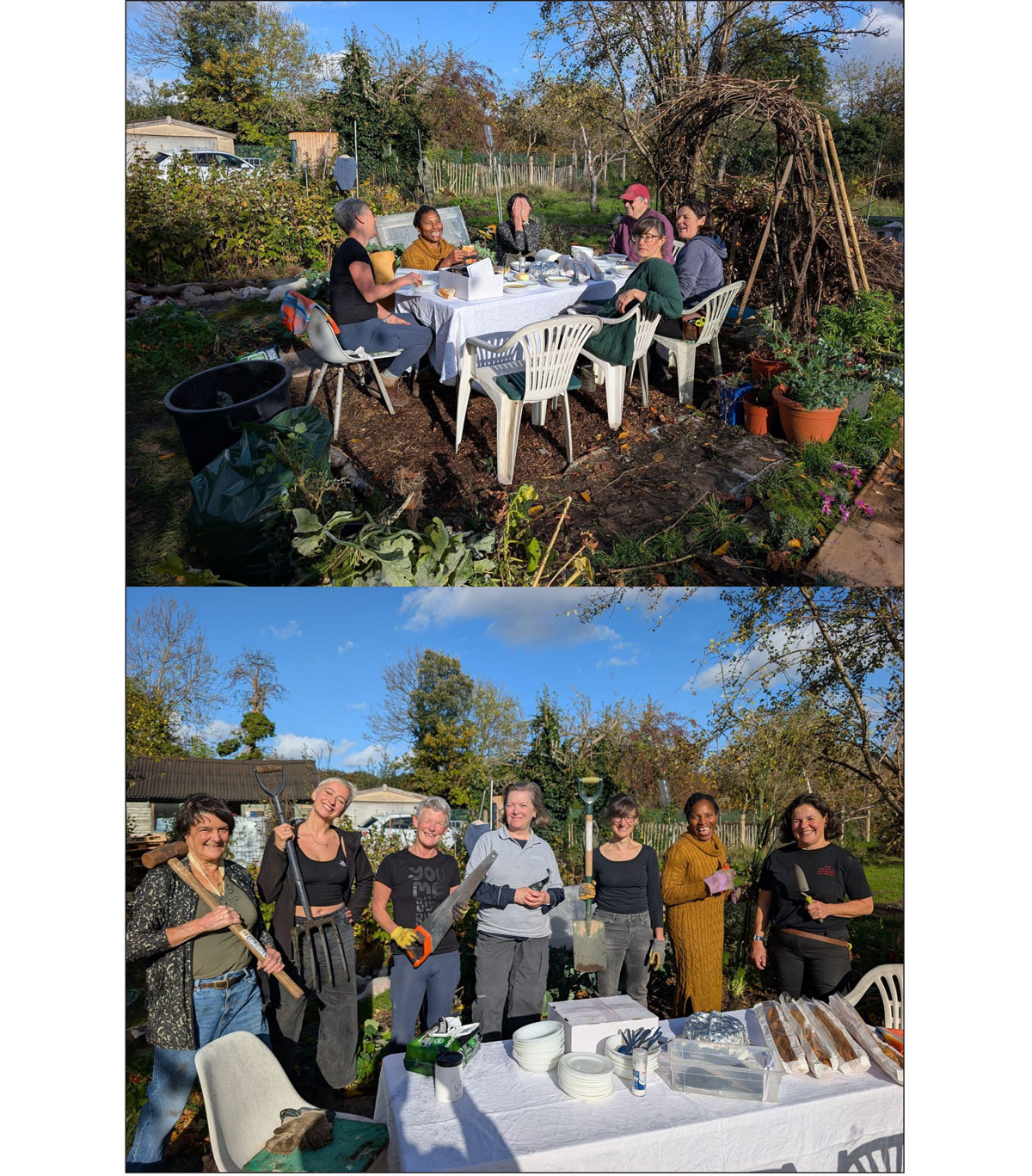
Permablitz at Debbie’s allotment, Mitcham, South London, 1 November 2025. Photos my own – shared with permission from Permablitz London..
Here, a group of women sit at a makeshift table for an outdoor lunch, talking, laughing, sharing homemade soup to nourish themselves for another few hours of gardening work. It is unseasonably warm, a gift of a day. In the photo above, we squint or close our eyes, dazzled by the unexpected sun (Figure 2 – I am second from left). We are an eclectic and intergenerational bunch, of different ages, jobs, and backgrounds – some of us met for the first time that morning, and others have worked together for years.
We gathered on that day as volunteers through a community organisation called Permablitz London. Permablitz’s aim is “to connect people [of London] with each other and the land” through gardening sessions and educational programmes rooted in the principles of permaculture,18 a design approach which aims to mimic the functioning of natural eco-systems.19 When I started volunteering with Permablitz in 2022, I knew nothing about gardening, and hadn’t planted a seed since I was a child. Now, I am confidently growing raspberries, asparagus, herbs, garlic, shallots, courgettes, and pumpkins in my quarter-plot allotment, with methods that apply what I have learned from Permablitz about nurturing soil ecology. I learned the word permaculture from reading solarpunk anthologies, and in the Google ramble that ensued, I found Permablitz.
As we prune, dig, feed, and water, the cycles and webs of nourishment that we exist within seem palpable. We ingest solar energy from the photosynthetic plants we eat, who have the ability to convert the sun’s rays into a form humans can consume. Reciprocally, our mitochondria, in the process of converting nutrients into usable chemical energy for us, produce CO₂ as a waste product of respiration, which nourishes plants.20 In addition, the ebb and flow of UV light intensity across diurnal cycles is intricately intertwined with the functioning of the human body. While the dangers of over-exposure are well-known, sunlight is of primary importance to human health, including the regulation of melatonin levels and blood pressure, Vitamin D synthesis, and boosts to serotonin levels.21 Something about the golden light dancing across leaves on a day of gardening makes these relationalities shimmeringly visible.
The sun is not always so visible on days spent with Permablitz, who run their volunteer sessions rain or shine. This aspect of my relation to solarity calls into question aspects of cultural, geopolitical, and climatic positionality. Raised in infamously grey and cloudy England, I am in a perpetual state of longing for the appearance of the sun, which so transfigured my mood on that November day – despite the strangeness of its warmth so late in the year. The implications of this longing must be critically excavated as I conduct my present research; the sun, of course, is also “bleak”,22 fearsome, and dangerous. I was in London on July 19, 2022, when we experienced temperatures of over 40 degrees for the first time. That day is vividly memorable; the inability to cool myself down was nerve-wracking and strangely claustrophobic. The university campus I usually teach on was closed, due to concerns about the heat – we were told to work from home. My partner and I attempted to do so in our rented flat, which like most UK buildings, does not have air conditioning. We blasted electric fans that uselessly wafted hot air, piled ice-cubes into pots and pans that we stuck our feet into for a moment’s relief. This unprecedented heat was uncomfortable and threatening for everyone, but for some, it was also lethal.23
As the devastating impacts of anthropogenic warming continue to unfold globally, climate justice provides an urgent framework to understand how the regions and demographics most impacted are those least responsible for the climate crisis.24 The greatest suffering and loss is taking place in the “tropical belt that is home to… much of the biodiversity of Earth” and 85% of its poorest people.25 Bodies most frequently subjected to overheating are often the same bodies whose own energy is exhausted by extractive forms of labour in both the Global North and South: “those workers who are involved in outdoor labor, such as in construction and agriculture”, often workers whose histories of migration and socioeconomic marginalisation inhibit their agency to set boundaries against dangerous work in too-high temperatures.26
What tropes and realities of these everyday “solarities”, both “bright” and “bleak”,27 does solarpunk collage and speculate from, in its many fictional worlds? In what ways are these collaged fictions simultaneously problematic and generative, as we grapple with futures that may emerge from the ruins of climate crisis? The text below is split into two sections that differently address these questions. The first explores a solarpunk short story that engages with contemporary solar technology as liberatory infrastructure (‘Dreams of Energy Sovereignty’). The second asks how two further example stories may complicate and expand understandings of solarity and dependence (‘Realities of Energy Transition’). This article is in dialogue with Rhys Williams’ critique of solar technology fetishism in the first published scholarly article on solarpunk back in 2019.28 I am also indebted to Alf Hornborg’s anthropological work on solar energy, technology, and magic, which illuminates a range of ways to read the solarpunk genre.29 I spend time below re-telling the three focal stories; in parallel to the embodied approach in the section above, this is done in the interests of developing what Robert D. Romanyshyn has called an “alchemical hermeneutics”.30 Alchemical hermeneutics, as an interpretive framework, draws attention to the transformative and imaginal phenomenology of reading, rather than extracting only those portions of literary text which support a predetermined hypothesis. By briefly re-telling the stories, I hope to provide the reader of this article with glimpses of an immersive (not just analytical) experience of the stories in question.
Dreams of Energy Sovereignty: Olokotun’s Solar Powered Neighbourhood
Deji Bryce Olukotun’s 2021 short story ‘The Scent of the Freetails’ tells the tale of a low-income solar-powered neighbourhood who have achieved full energy sovereignty from both the state and corporations.31 Olukotun’s setting is 2050 San Antonio, Texas, in a small, off-grid neighbourhood named La Estrella. The solar technology that powers La Estrella is owned by residents. Olukotun’s protagonist, Raj, is making a reluctant journey from Houston to La Estrella with his wife and daughter, to determine whether they might move there. Raj is hostile to the idea, having heard nothing but bad news about La Estrella in the press, and fearing the unknown. The area is “shrouded in… mystery—not even searchable on satellite view. Photos and videos were geofenced so that they couldn’t leave”.32 Raj’s wife has encouraged him to “give [it] a chance” in the light of more positive observations in phone calls with her cousin Yeimi, who moved there recently with her family.33 “It’s one of the only neighborhoods we could afford here,” his wife reminds him pragmatically, while Raj ruminates on news reports of violent crime and rampant drug use, terrified for his young daughter, who lives with impaired mobility.34
After they arrive, an entirely different narrative begins to emerge. Yeimi’s husband, Peter, explains how the community liberated themselves from state and corporate systems:
We all chip in towards the batteries. Since we’re equal partners with the grid, we get paid when we contribute more than we take. They [state or corporate authorities] can’t just look at our usage and charge us accordingly, because we’ve walled that off too. If they want access to our data, they can pay for it. Otherwise, we’re a black box to them.35
He also explains to Raj how the stigma about La Estrella in the mainstream press results from this rebellion against “the data lords”, acknowledging the reports of “crime. Rape. Murder. Anything they can throw at us. [They] didn’t forgive us when we started keeping our information from them”. In reality, La Estrella is a safe, close-knit community in a beautiful area, with colourful houses painted in pastel colours and solar cells seamlessly woven into the walls and pavements. It is also the first neighbourhood within the San Antonio city limits to have become a Dark Sky Community, “making it an excellent spot for stargazing” and for watching the night flight of the Mexican freetail bats, who are thriving there.36 This is partly because the residents are living in much closer attunement with diurnal cycles. To moderate their consumption of energy, residents try to use less electricity during hours of darkness. The nighttime streets are softly lit by fibre-optics in delicate shades of blue and green. Peter comments “some people don’t like having to put down their hairdryers at night when the great battery in the sky turns off” but for him, this way of living is “more mindful” – even “how we were meant to live”.37
At dusk, the whole community gathers outside in a celebratory spirit to watch the freetail bats take flight from a bridge in the centre of town. The sound of a neighbour’s trumpet drifts through the air as the crowd counts down together to sunset. Walking to the bridge, hand-in-hand with his wife, Raj “c[a]n’t recall the last time they’d gone for a stroll anywhere except when they were on vacation – their neighborhood in Houston only had one sidewalk, and it led to the convenience store”. In his encounter with La Estrella, he realises how disconnected he usually feels from his neighbours and immediate landscape.38
Questions of class and racial justice form a thread woven tightly through ‘The Scent of the Freetails’. Raj is Guyanese and has married into a Mexican family. The family’s economic precarity is central to the story, and is entangled with the theme of energy transition – Raj works in oil remediation, his clients rapidly declining since the collapse of the oil market. Through Olokotun’s deft narrative structure, with a well-placed sketch of a childhood visit to the Alamo in the story’s opening, the author implicitly connects Raj’s initial hostility towards La Estrella to the racial trauma of his formative years. Olukotun positions Raj as an unreliable narrator, whose unquestioning belief in the distorted media narratives of La Estrella’s criminality is – unconsciously – intertwined with memories of his early repression of his Guyanese identity and the traumatic impacts of white supremacy. The racism he experienced as a child on his arrival in Texas (“he’d decided to assimilate to the best of his ability…become a Texan”) leads to his subsequent, semi-conscious acceptance of white America’s respectability politics as a route to safety: “It had… made him into the man he was today: found him a profession, a family, and a place to call home”.39
La Estrella disturbs Raj because it intrudes on this sense of stability. Its pastel houses “remind[ed] Raj of the vibrant neighborhoods he’d been raised in back in Georgetown”, and the hug with which Yeimi greets him provides a warmth “he couldn’t help but return… Guyanese and Mexicans shared a love of welcomes and goodbyes”.40 By the end of the story, there is a sense that La Estrella is about to break through Raj’s defences and show him a different way to live, in pride and connection. In these stories, as in many other solarpunk fictions, energy sovereignty facilitates the empowerment of marginalised forms of identity and community structures, by assuring survival and safety outside the ‘grid’ of dominant power systems and their ideological demands.
This empowerment, however, does not straightforwardly equate to local self-sufficiency. What Olukotun does not investigate (nor does he claim to) is the global supply chain implicated in the industrial manufacturing of those solar cells, panels and storage batteries currently needed for such projects of community energy sovereignty in the US. As Rhys Williams pointed out seven years ago in the early days of solarpunk, the depiction of energy-sovereign groups who rely on modern solar arrays is in actuality an “imaginary of consumption”, not production or self-sufficiency. This is because the industrial manufacturing of such technologies demands extractivist infrastructure, which perpetuates neocolonial patterns of resource exploitation. It also involves energy-intensive processes, which would not currently be possible on a ‘DIY’ or cottage-industry basis. The manufacturing and distribution of solar tech involves, for example, the extraction of lithium and cobalt for storage batteries, and equipment to heat silicon to 2,000°C to make solar panels. The huge factories and mines required for these processes, to meet the scale of demand that global technological transition would entail, form an infrastructural backdrop excluded from the overt settings of many solarpunk stories.41
With this critique in mind, it is still crucial to defend radical aspects of solar technology, and the potential generativity of fictional portrayals of this in solarpunk. To provide a forceful example, last June, at a postgraduate research conference I attended at Birkbeck, University of London, Professor Ahmad Kamal Junina spoke to us by video-call from Gaza. He showed us a photo of the solar panel his laptop was hooked up to, his only source of power. His ability to communicate with us, in a situation of such infrastructural and necropolitical devastation, was contingent on this technology. The stakes of this communication, given the need for global solidarity to fight the Israeli government’s genocidal strategies, were desperately high.42 Those who may be forced into a position where ‘off-grid’ is the only option are likely to have a profound understanding of the complexities of reliance on industrial technology, but the reality is that none of us can yet fully extricate ourselves from it.
As we navigate these tensions, the portmanteau that forms ‘solarpunk’ is illuminating. Many solarpunk stories are ‘punk’ through solar technologies, depicting the rebellious, provisional and DIY processes of withdrawing from modernity’s fossil-fuelled energy grids. However, it is within the scope of solarpunk’s ambitions to be equally ‘punk’ about solar, applying this resourceful and sceptical attitude to solar technology itself and its supply chains. The latter necessitates a thorough reconceptualization of ‘transition’ and the complicities it entails, which the two stories below explore.
Realities of Energy Transition: Divya’s and Ilanko’s Elemental Solarities
In his introduction to the 2023 solarpunk anthology Fighting for The Future, the Afro-Trinidadian anarchist Andrew Sage observes “the wielding of solar energy need not be limited to conventional solar panels”.43 The ramifications of Sage’s comment unfurl in the light of anthropologist Alf Hornborg’s work on magic and technology. For Hornborg, the photovoltaic solar panels and storage batteries that constitute solar-energy arrays are paradigmatic examples of what he calls “global magic”: technology that occludes its own origins and consequences in terms of the flow of global resources. There is a contemporary tendency to view the solar panel as the synecdochal solution to the climate crisis, without considering this object’s relational features – how it is manufactured and distributed. This techno-fetishism, a Marxian term borrowed by Hornborg, is a hallmark of modern thinking. Ironically, pre-modern forms of solar worship dismissed as superstitious or magical thinking from the perspective of modernity, are anchored in a more robust biophysical reality – the Sun’s power – than the messianic agency that “moderns” often ascribe to technological objects.44
The fetishised technological object is only made possible by the symbolic entity that is money. In a financialised global economy where money has long departed from any anchoring in physical matter, “everything that humans desire [is] commensurable and interchangeable”, making it possible to exchange “rainforests” with “Coca-Cola” (or a lithium battery).45 Technological objects are manufactured through cheap labour with inexpensive raw materials from extractive zones, and exported to consumers dissociated from the true cost of what they are buying. The trajectory moves from pre-modern worship of the real energy of the sun, and the dependencies that entails, to an enmeshment with the “fictive energy” of de-materialised money, which “is imagined as a vital flow that nourishes society” and is able to “grow” by itself.46
This article, however, asks whether there is a more elemental form of solar imaginary that emerges through solarpunk – one that is centrally engaged with source and that generates curiosity about where everything comes from. Some solarpunk stories undeniably contribute to techno-fetishistic idealisation, by positioning the contemporary solar array as a magical panacea. Many other stories move through and beyond this trope, to invoke a more primordial relationship with the sun and the lifeworlds it nourishes. Paradoxically, the latter form of solarity may re-awaken a profound sense of connection with the very biophysical relationships, including supply chains, that technological objects often seem to obscure. This section marks an exploratory effort to construe solarpunk in relation to such ontological questions.
In S.B. Divya’s 2021 short story, ‘Things That Bend, But Don’t Break’, seventeen-year-old protagonist Tanama sets out to defend her girlfriend Yuisa’s community, “La Granja”, against eviction from the land they live on.47 Located just outside San Juan, Puerto Rico, La Granja is a self-sustaining community, described variously in the story as a “settlement” or “encampment”, composed of about a dozen houses underneath a “solar canopy”. Yuisa is described as the “mad genius” behind the design of La Granja.48 Most significantly, in terms of our current line of enquiry, Yuisa is using jackfruit to manufacture a type of energy storage battery to use in their solar array. Jackfruit trees prosper in full sun and a warm, humid climate, and a grove of them is thriving within the La Granja settlement.
Legally, the land that La Granja occupies is owned by a wealthy heiress who no longer lives in Puerto Rico. Though “nobody [was] using that land” previously, and the group has subsisted there for over a year, they are abruptly served a two-week eviction notice.49 Tanama’s mother rolls her eyes at her daughter’s outraged reaction: “I told you this was a bad idea. Just because the owner isn’t in Puerto Rico doesn’t mean they’re not paying attention. They hire people to check”.50 Determined not to lose the land and what the community have built with it, Tanama comes up with a financial plan where Yuisa can sell the jackfruit batteries to generate income that can be used to pay rent to the landowner. They send this proposal to the owner, who surprisingly consents, noting Yuisa’s indigenous heritage: “Some could argue that your Taíno ancestors have more claim to [the land] than I do, and that’s partly why I’m willing to give your venture a chance”.51
‘Things That Bend, But Don’t Break’, as its title suggests, is a story of transition, resilience, and adaptation. As a group of Sydney-based researchers found in 2020, bio-waste from jackfruit or durian fruit does indeed have potential to provide a viable alternative to lithium-ion batteries. The creation of supercapacitators from this bio-waste currently involves heat and freeze-drying, but the processes are not as unattainable on a cottage-industry level as those involved in lithium-ion battery manufacturing.52 Readers of Divya’s story may be surprised by the wide variety of possible material sources that might replace the substances in lithium-ion batteries, which include fruit, wood,53 and soil.54 This was new information for me as a reader, and the story brought it to my attention in an accessible and situated format. Technological progress is often portrayed as inevitably proceeding in a particular direction and inevitably generating a certain type of object – cold, hard, metallic, electronic, masculinist – detached from its source.55 The settings and iconography of solarpunk may call this mode of futurity into question.
Another intriguing aspect of the story is Tanamo and Yuisa’s disagreement about the plan to sell the batteries. Yuisa is initially hostile to this proposition, arguing “[t]he whole point of La Granja is to be self-sustaining. Selling batteries turns us into a business like everyone else, and I don’t want to do that,” to which Tanamo gently responds “[s]elf-sustaining doesn’t have to mean separate from the world”, reminding her of the precarity they live with and how precious La Granja has been to them.56 The persistence of La Granja could generate new possibilities for the future, and to throw that away on principles of purity and perfectionism is unacceptable to Tanama.
This spirit of compromise and openness during transition is also characteristic of Tehnuka’s short story ‘El, the Plastotrophs and Me’ (2023).57 This story is set in a fictionalised future Aotearoa (New Zealand), where small devolved villages work in tandem with still-existent, but crumbling, megacities to experiment with the feasibility of alternative sustainable lifestyles, as models that the citydwellers can eventually follow. Maori language, vernacular design, and ethical principles infuse the story, along with Tamil influences from the protagonist’s (and author’s) heritage. Tehnuka also depicts the presence of organic biotechnologies, where plastotrophs (plastic-eating bacteria) and carbon-fixing organisms labour alongside human co-workers to eradicate waste and reduce carbon levels. Solar-energy technologies are mentioned indirectly: the co-op’s elders are able to “telecomm” other villages, but are unable to do this when the weather is cloudy, implying that the solar array is used to a limited extent with less reliance on storage batteries.58 The devolved villages, “small co-ops” in Ilanko’s terms, are slowly figuring out how to build a viable and even joyful life with fewer resources, but the energy-intensive facilities of the cities, or “supercommunities” continue to function as a temporary safety net. “[I]t’s a harder life in our small co-ops,” the protagonist Malar observes, “but we do have the satisfaction of contributing that experience to the supercommunities as they make their slower transition to living lightly”.59
The story charts Malar’s frustration, doubt, and tenacity, as she worries it is taking too long to forge this new kind of low-tech life: “we co-ops are [still] reliant on the resources of supercommunities. We, who are supposed to lead the way, cling to them… Medical help, lab tests… factories to make what we aren’t ready to cope without”. Her patient partner Yoshi reassures her: “We’re finding out what’s truly essential… You know it won’t happen overnight… Treating our rohe [territory] as too much of a closed system is as dangerous as considering the world an endless resource”, in a comment reminiscent of Tanamo’s on self-sufficiency and separation.60 The story ends with an image of “light through clouds [and] the current of the river”:61 an apt reminder that the promises of solarity are never wholly bright, nor wholly bleak, but persist, ebb, and flow as an undercurrent of possibilities that prefigure futures beyond the dominance of fossil capitalism. Depicting and enacting these possibilities is the imperfect and committed project that solarpunk offers up to its readers and practitioners.
Conclusion
Reflecting on energy transition, the After Oil Collective reminds us of the truism “we shouldn’t let perfect be the enemy of good”.62 They note the tremendous difficulties involved in celebrating the possibilities that emerge through decentralised solar-technology infrastructure, in our current reality where “the self-determination of one community [is] intertwined with the continued dispossession and oppression of another” through “extraction and mining”. In a future built on “principles of solarity”, they suggest “particular extractive relations may remain as material residues from our extractivist past and present, but so, too, will emerge new and previously subdued possibilities for relations of reciprocity”.63 Attending to such possibilities may reveal more radical and non-extractive paths forward. In transitional contexts in particular, a full understanding of the possibilities of relationality may emerge through what Nat Raha and Mijke van der Drift, following Fred Moten, have called “active complicity”, a willingness to “[find] oneself the problem, without lapsing into guilt, defending ignorance, or hoping for a world in which innocence is an option”.64 Like solar power, revolutionary energy has the potential to nourish, to warm, but also to damage, to scald, what it intends to grow.
In solarpunk fictions, the sun provides a figural lens through which to imagine these reciprocal relations, to comprehend our planetary entanglements. Its storytellers exhibit a courageous willingness to venture into the twinned terrains of desire and sacrifice in the midst of modernity’s death throes. My readings of these stories, alongside my permaculture work in London, constantly force the questions: What could I give up for a better world? What might I gain in return? What can I learn from my longing for the sun?
Notes
- The following blog post is credited with coining the term ‘solarpunk’: john-robert, ‘From Steampunk to Solarpunk’, Republic of the Bees, 30 April 2008 <https://republicofthebees.blogspot.com/2008/04/from-steampunk-to-solarpunk.html>. [^]
- Solarpunk Community, ‘A Solarpunk Manifesto’, ReDes – Regenerative Design, n.d. <https://www.re-des.org/es/a-solarpunk-manifesto/> [accessed 14 March 2025]. [^]
- For example, ‘r/solarpunks’, Reddit, 2 November 2014 <https://www.reddit.com/r/solarpunk/> [accessed 2 April 2026]; London School of Solarpunk, ‘@solarpunkldn’, Instagram, n.d. https://www.instagram.com/solarpunkldn/ [accessed 29 March 2026]. [^]
- Solarpunk: histórias ecológicas e fantásticas de um mundo sustentável, ed. by Gerson Lodi-Ribeiro (São Paulo: Editora Draco, 2012). [^]
- Solarpunk: Ecological and Fantastical Stories in a Sustainable World, ed. by Gerson Lodi-Ribeiro, trans. by Fábio Fernandes (Albuquerque, NM: World Weaver Press, 2018). [^]
- Sunvault: Stories of Solarpunk and Eco-Speculation, ed. by Phoebe Wagner and Brontë Christopher Wieland (Nashville, TN: Upper Rubber Boot Books, 2017). [^]
- Phoebe Wagner and Brontë Christopher Wieland, ‘Sunvault: Stories of Solarpunk & Eco-Speculation’, Kickstarter, 1 June 2018 <https://www.kickstarter.com/projects/1917678918/sunvault-stories-of-solarpunk-and-eco-speculation> [accessed 1 April 2026]. [^]
- ‘About’, Solarpunk Magazine, 18 August 2021 <https://solarpunkmagazine.com/about/> [accessed 1 April 2026]. [^]
- ‘About Imagine 2200’, Grist, n.d. <https://grist.org/about-imagine-2200-climate-fiction/> [accessed 1 April 2026]. [^]
- Solarpunk Community. [^]
- Almanac for the Anthropocene: A Compendium of Solarpunk Futures, ed. by Phoebe Wagner and Brontë Christopher Wieland (Morgantown, WV: West Virginia University Press, 2022). [^]
- ‘r/solarpunks’, Reddit. [^]
- ‘@solarpunkldn’, Instagram. [^]
- After Oil Collective, Solarities: Seeking Energy Justice, ed. by Ayesha Vemuri and Darin David Barney (Minneapolis, MN: University of Minnesota Press, 2022). This definition does not appear on a numbered page, but in the front matter of the book. [^]
- Alf Hornborg, Global Magic: Technologies of Appropriation from Ancient Rome to Wall Street (London: Palgrave Macmillan, 2016), p. 76. [^]
- Stacey Balkan discusses this in the context of Begum Rokeya’s 1905 “proto-solarpunk” novella Sultana’s Dream in her article ‘Electric Ladyland: Anticolonial Solarpunk as Infrastructural Resistance in Two Works of Speculative Fiction’, ISLE: Interdisciplinary Studies in Literature and Environment, 24 July 2024, doi:10.1093/isle/isae043. [^]
- Vittorio Gallese and Hannah Wojciehowski, ‘How Stories Make Us Feel: Toward an Embodied Narratology’, California Italian Studies, 2.1 (2011), doi:10.5070/C321008974. [^]
- ‘Permablitz London’, Permablitz London website, n.d. <https://www.permablitzlondon.com> [accessed 2 April 2026]. [^]
- Terry Leahy, The Politics of Permaculture (London: Pluto Press, 2021). [^]
- Andrew Huberman, ‘Improve Energy & Longevity by Optimizing Mitochondria with Dr. Martin Picard’, YouTube, 15 December 2025 <https://www.youtube.com/watch?v=nMkQUlBtFlk> [accessed 19 July 2026]. [^]
- M. Nathaniel Mead, ‘Benefits of Sunlight: A Bright Spot for Human Health’, Environmental Health Perspectives, 116.4 (2008), pp. 160–67, doi:10.1289/ehp.116-a160. [^]
- After Oil Collective, p. 29. [^]
- UK Health Security Agency, ‘Heat Mortality Monitoring Report: 2022’, GOV.UK, 3 April 2025 <https://www.gov.uk/government/publications/heat-mortality-monitoring-reports/heat-mortality-monitoring-report-2022> [accessed 2 April 2026]. [^]
- Ashley Dawson, Environmentalism from Below: How Global People’s Movements Are Leading the Fight for Our Planet (Chicago: Haymarket Books, 2024). [^]
- After Oil Collective, p. 30. [^]
- Ibid., p. 31. [^]
- Ibid., p. 29. [^]
- Rhys Williams, ‘“This Shining Confluence of Magic and Technology”: Solarpunk, Energy Imaginaries, and the Infrastructures of Solarity’, Open Library of Humanities, 5.1 (2019), pp. 1–36, doi:10.16995/olh.329. [^]
- Hornborg. [^]
- Robert Donald Romanyshyn, The Wounded Researcher: Research with Soul in Mind (New Orleans, LA: Spring Journal Books, 2013). [^]
- Deji Bryce Olukotun, ‘The Scent of the Freetails’, in Cities of Light: A Collection of Solar Futures, ed. by Joey Eschrich and Clarke A. Miller (Tucson, AZ: Arizona State University Press, 2021), pp. 186–205. [^]
- Olukotun, p. 198. [^]
- Ibid. p. 191. [^]
- Ibid. p. 188. [^]
- Ibid. p. 199. [^]
- Ibid., p. 192. For explanation of Dark Sky projects, see DarkSky, ‘Dark Sky Places’, DarkSky International, 11 September 2024 <https://darksky.org/what-we-do/international-dark-sky-places/all-places/> [accessed 13 October 2025]. [^]
- Olukotun, p. 199, p. 201. [^]
- Ibid., p. 201-2. [^]
- Ibid., p. 190. [^]
- Ibid., p. 193–4. [^]
- Williams, p. 20. [^]
- Ahmad Kamal Junina, ‘Pedagogical Resilience, Challenges and Adaptive Strategies: A Collaboration with scholars of Al-Aqsa University in Gaza’, CHASE-DTP Annual Conference: ‘Plural Worlds’, Birkbeck, University of London, June 19 2025. [^]
- Andrew Sage, ‘Introduction’, in Fighting for the Future: Cyberpunk and Solarpunk Tales, ed. by Phoebe Wagner (Eugene, OR: Android Press, 2023), p. Ix–xiii, p.xii. [^]
- Hornborg. [^]
- Ibid. p. 160. [^]
- Ibid. p. 155. [^]
- S. B. Divya, ‘Things That Bend But Don’t Break’, in Cities of Light, Eschrich and Miller. [^]
- Ibid., pp. 138–9. [^]
- Ibid., p. 145. [^]
- Ibid., p. 142. [^]
- Ibid., p. 153. [^]
- Kenny Lee and others, ‘Aerogel from Fruit Biowaste Produces Ultracapacitors with High Energy Density and Stability’, Journal of Energy Storage, 27 (2020), p. 101-152, doi:10.1016/j.est.2019.101152. [^]
- Celia Jones, ‘How the World’s Smelliest Fruit Could Power Your Phone’, BBC Future, 27 July 2020 <https://www.bbc.com/future/article/20200724-the-battery-made-from-diamonds-that-could-last-1000-years> [accessed 18 October 2025]. [^]
- Gemma Ware, ‘What Will Batteries of the Future Be Made of? Four Scientists Discuss the Options – Podcast’, The Conversation, 17 July 2025, doi:10.64628/AB.3xp6sq3g5. [^]
- Jennie C. Stephens, ‘The Dangers of Masculine Technological Optimism’, Environmental Values, 33.1 (2024), pp. 58–70, doi:10.1177/09632719231208752. [^]
- Divya, p. 151. [^]
- Tehnuka, ‘El, the Plastotrophs and Me’, in Afterglow: Climate Fiction for Future Ancestors, ed. by Grist (New York: New Press, 2023). The author is mononymous. [^]
- Ibid. p. 167. [^]
- Ibid. p. 170. [^]
- Ibid. pp. 182-3. [^]
- Ibid. p. 184. [^]
- After Oil Collective, p. 43. [^]
- Ibid., my italics. [^]
- Nat Raha and Mijke van der Drift, Trans Femme Futures: Abolitionist Ethics for Transfeminist Worlds (London: Pluto Press, 2024). [^]
Bibliography
‘About Imagine 2200’, Grist, n.d. <https://grist.org/about-imagine-2200-climate-fiction/> [accessed 1 April 2026]
‘About’, Solarpunk Magazine, 18 August 2021 <https://solarpunkmagazine.com/about/> [accessed 1 April 2026]
After Oil Collective. 2022. Solarities: Seeking Energy Justice, ed. by Ayesha Vemuri and Darin David Barney (Minneapolis: University of Minnesota Press)
Balkan, Stacey. 2024. ‘Electric Ladyland: Anticolonial Solarpunk as Infrastructural Resistance in Two Works of Speculative Fiction’, ISLE: Interdisciplinary Studies in Literature and Environment, doi: http://doi.org/10.1093/isle/isae043
DarkSky. 2024. ‘Dark Sky Places’, DarkSky International <https://darksky.org/what-we-do/international-dark-sky-places/all-places/> [accessed 13 October 2025]
Dawson, Ashley. 2024. Environmentalism from Below: How Global People’s Movements Are Leading the Fight for Our Planet (Chicago: Haymarket Books)
Eschrich, Joey and Miller, Clarke A. (eds.). 2021. Cities of Light: A Collection of Solar Futures (Tucson, AZ: Arizona State University Press)
Gallese, Vittorio and Wojciehowski, Hannah. 2011. ‘How Stories Make Us Feel: Toward an Embodied Narratology’, California Italian Studies, 2.1, doi: http://doi.org/10.5070/C321008974
Grist (ed.). 2023. Afterglow: Climate Fiction for Future Ancestors (New York: New Press)
Hornborg, Alf. 2016. Global Magic: Technologies of Appropriation from Ancient Rome to Wall Street (London: Palgrave Macmillan)
Huberman, Andrew. 2025. ‘Improve Energy & Longevity by Optimizing Mitochondria with Dr. Martin Picard’, YouTube <https://www.youtube.com/watch?v=nMkQUlBtFlk> [accessed 19 July 2026]
john-robert. 2008. ‘From Steampunk to Solarpunk’, Republic of the Bees <https://republicofthebees.blogspot.com/2008/04/from-steampunk-to-solarpunk.html>
Jones, Celia. 2020. ‘How the World’s Smelliest Fruit Could Power Your Phone’, BBC Future, <https://www.bbc.com/future/article/20200724-the-battery-made-from-diamonds-that-could-last-1000-years> [accessed 18 October 2025]
Junina, Ahmad Kamal. 2025. ‘Pedagogical Resilience, Challenges and Adaptive Strategies: A Collaboration with scholars of Al-Aqsa University in Gaza’, CHASE-DTP Annual Conference: ‘Plural Worlds’, Birkbeck, University of London
Leahy, Terry. 2021. The Politics of Permaculture (London: Pluto Press)
Lee, Kenny, and others. 2020. ‘Aerogel from Fruit Biowaste Produces Ultracapacitors with High Energy Density and Stability’, Journal of Energy Storage, 27, p. 101–152, doi: http://doi.org/10.1016/j.est.2019.101152
Lodi-Ribeiro, Gerson (ed.). 2012. Solarpunk: histórias ecológicas e fantásticas de um mundo sustentável (São Paulo: Editora Draco, 2012)
Lodi-Ribeiro, Gerson (ed.). 2018. Solarpunk: Ecological and Fantastical Stories in a Sustainable World, trans. by Fábio Fernandes (Albuquerque, NM: World Weaver Press)
London School of Solarpunk, ‘@solarpunkldn’, Instagram, n.d. https://www.instagram.com/solarpunkldn/ [accessed 29 March 2026]
Mead, M. Nathaniel. 2008. ‘Benefits of Sunlight: A Bright Spot for Human Health’, Environmental Health Perspectives, 116.4, pp. 160–67, doi: http://doi.org/10.1289/ehp.116-a160
‘Permablitz London’, Permablitz London website, n.d. <https://www.permablitzlondon.com> [accessed 2 April 2026]
Raha, Nat, and van der Drift, Mijke. 2024. Trans Femme Futures: Abolitionist Ethics for Transfeminist Worlds (London: Pluto Press)
Romanyshyn, Robert Donald. 2013. The Wounded Researcher: Research with Soul in Mind (New Orleans, LA: Spring Journal Books)
‘r/solarpunks’. 2014. Reddit <https://www.reddit.com/r/solarpunk/> [accessed 2 April 2026]
Solarpunk Community, ‘A Solarpunk Manifesto’, ReDes – Regenerative Design, n.d. <https://www.re-des.org/es/a-solarpunk-manifesto/> [accessed 14 March 2025]
Stephens, Jennie C. 2024. ‘The Dangers of Masculine Technological Optimism’, Environmental Values, 33.1, pp. 58–70, doi: http://doi.org/10.1177/09632719231208752
UK Health Security Agency. 2022. ‘Heat Mortality Monitoring Report: 2022’, GOV.UK <https://www.gov.uk/government/publications/heat-mortality-monitoring-reports/heat-mortality-monitoring-report-2022> [accessed 2 April 2026]
Wagner, Phoebe (ed.). 2023. Fighting for the Future: Cyberpunk and Solarpunk Tales (Eugene, OR: Android Press)
Wagner, Phoebe and Wieland, Brontë Christopher (eds.). 2017. Sunvault: Stories of Solarpunk and Eco-Speculation (Nashville, TN: Upper Rubber Boot Books)
Wagner, Phoebe and Wieland, Brontë Christopher. 2018. ‘Sunvault: Stories of Solarpunk & Eco-Speculation’, Kickstarter <https://www.kickstarter.com/projects/1917678918/sunvault-stories-of-solarpunk-and-eco-speculation> [accessed 1 April 2026]
Wagner, Phoebe and Wieland, Brontë Christopher (eds.). 2022. Almanac for the Anthropocene: A Compendium of Solarpunk Futures (Morgantown, West Virginia: West Virginia University Press
Ware, Gemma. 2025. ‘What Will Batteries of the Future Be Made of? Four Scientists Discuss the Options – Podcast’, The Conversation, doi: http://doi.org/10.64628/AB.3xp6sq3g5
Williams, Rhys. 2019. ‘“This Shining Confluence of Magic and Technology”: Solarpunk, Energy Imaginaries, and the Infrastructures of Solarity’, Open Library of Humanities, 5.1, pp. 1–36, doi: http://doi.org/10.16995/olh.329