
The world has suffered many wars and conflicts and many innocent people have lost their lives in these wars. The most famous of these were World War I (with an estimated 16 million victims), World War II (nearly 61 million victims), and the Bolshevik Revolution (between 5 to 20 million victims).1 After these conflicts, peace prevailed and the world lived in relative tranquillity. But there is a region in this quiet world that doesn’t see peace or feel it: the Gaza Strip. Undoubtedly, there is a vast difference between the First and Second World Wars and the wars waged on Gaza: the World Wars were driven by goals of total hegemony over weaker nations and the sheer demonstration of power; however, the enemy launched the wars on Gaza to annihilate a people who represent a thorn in their side. Furthermore, the conflict between those of us in Gaza and our occupiers is, at its core, an ideological and existential struggle; it is a battle between the Quran and the Talmud, between truth and falsehood, and the two can never meet on the same ground.
Located along the Mediterranean Sea in southern Palestine, the Gaza Strip spans approximately 365 square kilometres and is home to around 2.5 million people. It is bordered by the Negev Desert to the east, international borders with Egypt and the Sinai Desert to the south, and the occupied Palestinian territories to the north. However, Gaza is more than just geography; it’s a land of dreams, strength, and unyielding resistance, embodied in its people, its nature, and even its stones. Yet, Gaza’s fate has been very hard: it has been forced to move from one war to another, barely recovering from the last before another more brutal one erupts. In Gaza, you witness unmatched resilience: defiant men, steadfast women, and children who become adults before their time. On this tiny strip of land you see what can’t be found elsewhere–beauty mixed with unimaginable pain. Of the many conflicts Gaza has suffered, the most devastating is arguably the ongoing one, which has lasted over 800 days, leaving tens of thousands dead, hundreds of thousands wounded, and millions displaced.2
The Oxford English Dictionary defines war as an ‘[a]rmed conflict between nations, states, or rulers, or between groups in the same nation or state […], typically characterized by a campaign or series of campaigns conducted over a period of time’.3 However, in Gaza, war has many definitions: if you ask one group of people in Gaza what war means to them they will tell you that war is ‘losing all the members of your family and remaining alone in this life’; another person will define war as ‘losing your home or being forced to flee your home with your family to become one of the homeless and to continue your life living in a tent that protects neither from cold, nor heat, nor death’; another person may belive that war is being starved with your family, seeing your children cry because they are hungry and not being able to do anything to help them survive because you are living under a complete siege. Having lived through a war that has levelled everything in its path, I define war as ‘destruction and the absence of life’. In my memory, the word ‘war’ is inextricably linked to the slaughter of the human mind and heart through the loss of loved ones. Everything else can be replaced, whether it is a bombed home, looted wealth, or forced starvation. But those we lose? There is no way to ever replace them, not until the end of time.
Of course, war doesn’t erupt between nations without reasons, there are always causes and consequences. They often arise between nations of comparable military and economic strength; as a means to assert geopolitical control over vital natural resources; to plunder economic wealth; and to exert extra political or cultural hegemony over weaker societies. However, war on Gaza has never been balanced in power between the parties; it is waged for one reason only: the Palestinian people’s aspiration for freedom and their determination to defend their sacred sites, including Al-Aqsa Mosque, the Dome of the Rock, the Ibrahimi Mosque, and other religious places that are an inseparable part of our faith and religion. Such are the demands of these conflicts on our religious sites that, as a 23-year-old, I have never been able to pray a single rak’ah in Al-Aqsa Mosque. For those of us from Gaza, the freedom of our holy sites is our own freedom. True liberty is the ability to move across your homeland without checkpoints, without arrests, and without an annexing wall that severs Jerusalem, the ‘Soul’, from the rest of the nation. What is the use of freedom if you are not free in your principles and faith within a liberated land? What is the value of resources if they are plundered? And what is the value of blood and souls if they are not sacrificed for a homeland and sanctities that embody both creed and dignity? War therefore erupts in Gaza because its people seek to live with dignity, to enjoy the rights afforded to other nations free from siege, deprivation and dependency on their oppressor.
To reiterate, the war between us and our enemy has never been a balanced one. We resist with meagre weapons against an enemy that deploys its entire lethal arsenal against us without mercy. What the oppressors fail to realise is that we do not fight with material weapons alone; we fight with our hearts and resist through our knowledge, continuing our journey as survivors, not as victims. They seek to erase us and wipe our heritage from this land, yet every tree, stone, and even the dust of this place knows that we are the rightful owners, and no interloper can ever truly possess it.
Whatever the cause, war has a disastrous effect on countries and their people. After the end of World War I and II, people lived in misery, as they did in Hiroshima after the nuclear bomb was dropped on it and in the amount of time it took to recover.4 Yet the effects of the war on Gaza surpass the limits of tragedy and all that the human mind can imagine. After the war on Gaza ends and the genocide stops, the huge number of people who have been made homeless or have been displaced will have reached nearly ninety percent of the population;5 a great number of children will have become orphans; women who became widows will take on the responsibility of supporting their families on their own; and there will be countless people who remain missing. In addition, the number of martyrs has reached more than seventy thousand, most of them women and children, a fact that the world has seemingly ignored.6 As the character Salam powerfully summarises in Ayman Al-Atoum’s novel Horror: A Tale of the War on Gaza, ‘When our childhood is slaughtered, the world falls silent’ and, just as powerfully, ‘they claimed to defend women […] yet they failed to see the women of Gaza buried beneath the rubble’.7
This horror is only the result of war from the human perspective, the most vital essence of existence. Without the individual, nations cannot rise, nor can civilizations flourish. It is the human being with their mind, intellect, soul, body, and energy who sustains the cycle of life. If you seek prosperity in any field, invest in the person and you will find that everything surrounding them prospers in turn. Conversely, if you seek the ruin and destruction of all forms of life, then destroy the human spirit, and you will find that all other elements crumble automatically.
Beyond the human impact, there are also catastrophic consequences for other components of society such as social services and education, the latter of which has either stopped completely or continued under great strain since the current war began.8 Healthcare services have also become difficult to access, and the economy is paralyzed due to the blockade, leading to the spread of starvation. In addition, destruction has also been inflicted on the environment, which affects all resources. For example, drinking water has become extremely scarce due to the shutdown of desalination plants. As for water for daily use, we have resorted to digging into the ground to access groundwater wells, waiting for them to flow once a week to fill barrels, as there is no longer the fuel needed to operate the generators that pump water into our homes.
In terms of food, individuals in Gaza are now unable to secure more than the bare essentials, anything beyond that depends on aid coupons and the canned goods they provide, which can harm health in the long term. The air has become heavy; you can hardly breathe it in without exhaling forcefully, your face darkened by dust mixed with burnt gunpowder. The soil has lost its natural components and is now saturated with chemicals from missiles, making it unsuitable for agriculture. This is not to mention the chronic shortage of medicine, the spread of hepatitis cases, and poisoning caused by insect bites in tents, along with diseases never heard of before. Furthermore, rubble now covers more than three-quarters of the Gaza Strip, making roads narrow, dusty, and difficult to navigate.
If this situation continues for a longer period, the destruction will only worsen, conditions will deteriorate further, and disease, poverty, and illiteracy will spread more widely. The sick will lose their lives, and those who remain will continue struggling to survive by any means until their time comes, like those before them.
Now, considering such widespread destruction, a question imposes itself on reality and lingers in the mind of everyone in Gaza: ‘Why can’t Gaza enjoy peace?’. While this question has many answers, I believe the answer is clear: the people of Gaza are fighting to protect their sacred land and they will continue doing so until the last day of their lives. Because the people of Gaza want to be free, they hope to see their dreams become real, and their great wish is to live without being killed each year by their occupier. Gaza cannot enjoy peace because the world we live in is without conscience; our world was and still is blind to the children of Gaza when they were killed and their limbs were amputated; our world that defends human rights wasn’t aware of the women of Gaza when their bodies were torn to pieces. The real answer to why Gaza can’t enjoy peace is simply because our civilised world lives in a deep slumber.
Notes
- For statistics on deaths in these respective wars see Dennis E. Showalter, ‘Killed, wounded, and missing’ Britannica, 2 January 2026 <https://www.britannica.com/event/Treaty-of-Versailles-1919> [accessed 3 January 2026]; ‘The Cost of Victory’, The National WWII Museum, n.d. <https://www.nationalww2museum.org/war/articles/cost-victory#:~:text=Sixty%20million%20people%20died%20in,some%20way%20by%20the%20war> [accessed 3 January 2026]; ‘الثورة التي غيّرت العالم.. 9 حقائق مهمة عن الثورة البلشفية الروسية’ (The revolution that changed the world: 9 important facts about the Russian Bolshevik Revolution)’, Arabic Post, 20 July 2020 <https://arabicpost.net/> [accessed 10 December 2025]. [^]
- ‘التبليغ عن الشهداء والمفقودين (Reporting on martyrs and missing persons)’, Palestinian Ministry of Health, n. d. <https://sehatty.ps/moh-registration/public/add-order> [accessed 10 December 2025]. [^]
- ‘War, N. (1).’ Oxford English Dictionary, n.d. <https://www.oed.com/dictionary/war_n1?tl=true> [accessed 3 January 2026]. [^]
- As an illustrative example, see ‘The Realities of Atomic Bombing’, The City of Hiroshima, n.d. <https://www.city.hiroshima.lg.jp/english/peace/1029920/1009857.html> [accessed 3 January 2026]. [^]
- Agence France-Presse, ‘About 90% of people in Gaza displaced since war began, says UN agency’, 3 July 2024 https://www.theguardian.com/world/article/2024/jul/03/about-90-of-people-in-gaza-displaced-since-war-began-says-un-agency> [accessed 3 January 2026]. [^]
- Palestinian Ministry of Health. [^]
- Ayman Al-Atoum, الرعب حكاية الحرب على غزة [Horror: A Tale of the War on Gaza] (Al Ghawthani, 2024), p. 27, 34 (translated by the author). [^]
- Ahmed Kamal Junina, ‘Displaced but not replaced: challenges, adaptations, and resilience of higher education in Gaza in the context of war and scholasticide’, Globalisation, Societies and Education, published online 16 July 2025, doi: 10.1080/14767724.2025.2532022. [^]
Biography
Shahd Ismail Miqdad is a 23-year-old woman living in Gaza’s central governorate. A graduate majoring in English Language from Al-Aqsa University’s Faculty of Education, Shahd has a deep passion for reading books and novels, especially the poetry of Mahmoud Darwish and the literature of Ghassan Kanafani. She also enjoys learning languages, including French and Hebrew.
Shahd’s journey in writing began with reading and critically analysing books. However, during the war, writing became her refuge, something that heals her soul, with personal loss being the main reason for writing stories and poetry. For Shahd, writing is a reflection of the self, a freedom of the spirit, and a voice that never fades.
Shahd’s written work has taken several forms in recent years. The poem ‘When’ was written on September 19, 2025, after she lost four of her aunt’s children when their home was bombed and can be found here. Another poem, ‘When Resilience Breathes’, was written on International Women’s Day, 2026. Shahd has also showcased her work in podcast form, including a recording of her short story “I felt the missile has exploded inside my heart” as part of the British Council’s Resilient Voices project. A recent interview with PalCast can also be found here.
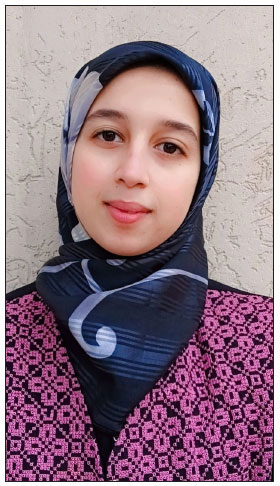
Photograph of the author, courtesy of the author.
Bibliography
Agence France-Presse, ‘About 90% of people in Gaza displaced since war began, says UN agency’, 3 July 2024 <https://www.theguardian.com/world/article/2024/jul/03/about-90-of-people-in-gaza-displaced-since-war-began-says-un-agency> [accessed 3 January 2026]
Al-Atoum, Ayman, الرعب حكاية الحرب على غزة [Horror: A Tale of the War on Gaza] (Al-Ghawthani, 2024)
Junina, Kamal Ahmed, ‘Displaced but not replaced: challenges, adaptations, and resilience of higher education in Gaza in the context of war and scholasticide’, Globalisation, Societies and Education, published online 16 July 2025, doi: http://doi.org/10.1080/14767724.2025.2532022
Showalter, Dennis E., ‘Killed, wounded, and missing’ Britannica, 2 January 2026 <https://www.britannica.com/event/Treaty-of-Versailles-1919> [accessed 3 January 2026]
‘The Cost of Victory’, The National WWII Museum, n.d. <https://www.nationalww2museum.org/war/articles/cost-victory#:~:text=Sixty%20million%20people%20died%20in,some%20way%20by%20the%20war> [accessed 3 January 2026]
‘The Realities of Atomic Bombing’, The City of Hiroshima, n.d. <https://www.city.hiroshima.lg.jp/english/peace/1029920/1009857.html> [accessed 3 January 2026]
التبليغ عن الشهداء والمفقودين [Reporting on martyrs and missing persons]’, Palestinian Ministry of Health, n. d. <https://sehatty.ps/moh-registration/public/add-order> [accessed 10 December 2025]
‘الثورة التي غيّرت العالم.. 9 حقائق مهمة عن الثورة البلشفية الروسية’ [The revolution that changed the world: 9 important facts about the Russian Bolshevik Revolution]’, Arabic Post, 20 July 2020 <https://arabicpost.net/> [accessed 10 December 2025]
“War, N. (1).” Oxford English Dictionary, n.d. <https://www.oed.com/dictionary/war_n1?tl=true> [accessed 3 January 2026]