
Development corridors have become central instruments of economic policy and regional integration across Africa, with 79 recorded throughout the continent.1 The Lobito Corridor, connecting Angola, the Democratic Republic of Congo (DRC), and Zambia to global markets through the rehabilitation of the twentieth-century Benguela Railway, is assessed here as a revelatory case of this development model. Mainstream Development Organisations (MDOs) present such corridors as technical interventions that enhance connectivity, facilitate trade, and stimulate regional development.2 A growing body of critical scholarship, however, challenges technical framings of development corridors, demonstrating how they reproduce uneven development, extractive relations, and colonial geographies of accumulation, foregrounding labour, capital, and dependency.3
While such critical approaches highlight the political-economic relations embedded within corridors, they often retain an analytical separation between social relations and the socio-ecological relations through which accumulation is produced.4 Rather, by examining the Lobito Corridor through World-Ecology, this article reconceptualises development corridors not as contemporary infrastructure projects, but as constitutive of a longer historical process of frontier-making through which capitalism reorganises human and extra-human natures.5 It argues that successive infrastructural regimes—from caravan trade and colonial railway expansion to contemporary critical mineral logistics—have reorganised socio-ecological relations in the region, producing new frontiers through which capitalism secures cheaper conditions of accumulation.
Development Rationalities in the Lobito Corridor
The Lobito Corridor is a multimodal transport infrastructure system across Angola, DRC, and Zambia.6 Primarily structured around the Angolan Benguela Railway brownfield rehabilitation initiative, which extends from the western Port of Lobito to the eastern border with DRC (see Figure 1), the transport route historically facilitated the movement of agricultural and mineral commodities from the Copperbelt region and wider African interior to global markets under Portuguese colonial rule.7 Intersecting through their defining, financing, planning, and governing of the Lobito Corridor, a diverse coalition of actors is re-engaging with and reconfiguring the corridor in the twenty-first century. These actors—referred to here as Mainstream Development Organisations (MDOs)—include multilateral development banks (MDBs), international financial institutions (IFIs), regional organisations, states and national governments, as well as private market operators, each advancing varying developmental objectives.8
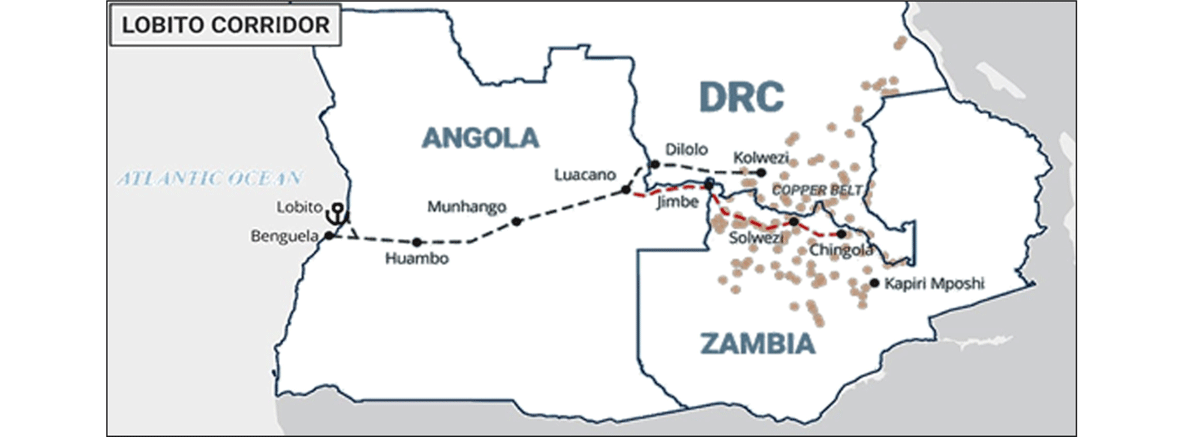
Fig 1: Map of the Lobito Corridor, showing the Benguela Railway as well as its existing and future connections to the Copperbelt. Zachary Fillingham, ‘The Lobito Corridor: Washington’s Answer to Belt and Road in Africa’, Geopolitical Monitor, 2024 <https://www.geopoliticalmonitor.com/the-lobito-corridor-washingtons-answer-to-belt-and-road-in-africa/> [Reprinted with permission from Geopolitical Monitor/Zachary Fillingham].
Across this re-engagement, spanning objectives of investment stability, regional integration, economic diversification, critical mineral procurement necessary for the ‘global green transition’, and foreign security imperatives, the following analysis traces how MDOs, through mutually reinforcing corridor strategies, create complementary institutional and territorial environments through which development is expected to occur.9 Following Sidaway, the discussion situates MDOs involved in the Lobito Corridor at the conjuncture of investment, statecraft, and territorial reorganisation.10 In doing so, it argues that the MDOs involvement may be understood through Schindler and Kanai’s concept of a ‘global growth coalition’—a heuristic for describing the partial convergence of diverse institutional actors around infrastructure, connectivity, and economic transformation.11
At the national scale, Angola, Zambia, and the DRC’s visions of the Lobito Corridor converge in framing its territory and infrastructure as a development strategy, embedding corridor space within national economic agendas and linking them through global market integration.12 Angola’s National Development Plan (2023–2027) which is aligned with the African Development Bank (AfDB) Country Strategy Paper articulates the corridor as a functional territory awaiting regional/global market linkages.13 Within this framework, the corridor links the expansion of non-oil productive sectors by connecting agricultural modernisation, critical mineral extraction, and industrial upgrading to export diversification as a pathway for integrating Angola into global value chains.14
In Zambia and the DRC, complementary logics frame the corridor as infrastructure for maximising local benefits from copper and cobalt extraction. It is leveraged as a platform for increasing capacity for domestic processing of critical minerals prior to global market circulation.15 Despite differences, the Lobito Corridor is consistently territorialised as a mechanism for development through deeper integration of domestic economies into regional and global agricultural and mining value chains: conditioning its constitutive infrastructures for enhanced economic connectivity that produces economic growth.
This logic is mutually reinforced by IFIs and MDBs that consequently intersect with practices of statecraft to produce an attractive corridor investment environment, framed as a means of stimulating economic development. The World Bank Multilateral Investment Guarantee Agency (MIGA) provides political/non-commercial risk insurance, reducing uncertainty of investment in the Lobito Corridor advanced by the operating consortium.16 Within a wider financing framework, the African Finance Corporation (AFC), Development Bank of Southern Africa and the U.S. Development Finance Corporation financing package for the operating consortium of the Lobito Corridor configure its constitutive infrastructure as an investable asset designed to mobilise private capital and catalyse economic development.17 For the AfDB this is underscored by the assumption that investment in development corridors is a catalyst for structural transformation – the shift towards industrial and market based economies.18 Within this framing, the Lobito Corridor is not only a domestic initiative, but additionally a financial object co-produced by MDOs to secure public and private investment flows that enable expanded circulation of commodities, labour, and capital, from which economic growth and development can occur across the region.
In response to this financial logic, regional organisations such as the Southern African Development Community (SADC) conditionally frame the Lobito corridor through implementing hard/soft-infrastructure integration.19 The SADC secretariat has signed, alongside the three corridor countries, the ‘Lobito Corridor Transit Transport Facilitation Agency Agreement’ intended to harmonise regulatory systems and facilitate cross-border circulation around competitive hubs and markets.20 At the geopolitical scale, this regional institutionalisation is reinforced by wider international initiatives. The seven-party Memorandum of Understanding (MoU) between the U.S., European Union (EU), Angola, DRC, Zambia, AfDB, and AFC, together with the EU Global Gateway, and the G7 Partnership for Global Infrastructure and Investment (PGII) position the Lobito Corridor as a strategic infrastructure project at the intersection of investment, statecraft, and territorial reorganisation.21 Alongside IFI and MDB market-centric approaches, the corridor territory is framed through the lens of critical mineral security and supply-chain resilience by PGII states, while for Angola, DRC, and Zambia it is simultaneously positioned as a strategy for infrastructure development, economic diversification, and regional integration.
Increasingly, these initiatives are articulated through the imperatives of the global energy transition. Within this framing, the corridor is positioned as a mechanism for security, strengthening critical mineral supply chains by linking extraction, processing, and manufacturing into more resilient value chains for renewable energy technologies.22 In doing so, the developmental priorities of Angola, the DRC, and Zambia become increasingly aligned with intersecting economic, energy, and security interests of Western states seeking to diversify critical mineral supply.23 As Carrai argues, China’s longer-standing infrastructural and extractive engagements in the region are vital, providing the prior material and institutional template for corridor-based development.24 The newer G7, EU, and US initiatives, assigning flagship status to the Lobito Corridor, are here not new but rather strategic recalibrations of earlier corridor development in the region.25
Across these multi-scalar articulations by diverse actors, the Lobito Corridor emerges not as a fragmented assemblage of competing development models. Rather, the corridor is structured through an infrastructure-led developmental rationality by which investment, circulation, and territorial reorganisation are consistently aligned with the imperatives of converging MDOs rationalities for corridor development – a ‘global growth coalition’.26
Development Corridors, Continuity, Dependency, and Extractivism
The preceding section demonstrated how development corridors are conceptualised by MDOs and how these imaginaries materialise in the contemporary redevelopment of the Lobito Corridor at the intersection of statecraft, investment, and territorial reorganisation. Critical corridor scholarship, however, challenges implicit MDOs assumptions that corridor infrastructures operate as technical mechanisms of economic development and connectivity.27 It situates corridors within longer historical trajectories of colonialism, uneven development, and extractive capitalism.28 The convergence of MDO rationalities in the Lobito Corridor outlined above are therefore here interpreted not as the mutual reinforcement of infrastructure-led development, but the historical reconfiguration of ‘development’ as a politically embedded common sense through which capitalist accumulation is organised and legitimised.
Read through a historical continuity lens the contemporary redevelopment of the Lobito Corridor appears less as a rupture with colonial geographies than as their reconfiguration.29 Although repositioned by MDOs as a vehicle for economic transformation, the rehabilitation of the Benguela Railway (Figure 1) reproduces a congruent spatial logic with the twentieth-century colonial pit-to-port system previously designed to move agricultural commodities and mineral resources from the African interior to external circuits of accumulation.30 As Enns and Bersaglio argue in their approach to assessing infrastructure-led development, corridors often ‘bring to fruition ambitions of the colonial past’ rearticulated through contemporary narratives of connectivity and efficiency.31 This call for a longue durée approach that can be extended to assessing contemporary MDOs involvement in the Lobito Corridor, intersecting through infrastructural governance regimes, financing, and trade facilitation that aligns the railways function with its colonial origins in imperial finance and export-oriented commodity trade that ‘continues to serve the interests of global capital’, preventing economic development across the region.32
For scholars such as Zajontz and Taylor, as well as Thame, this historical continuity is advanced beyond colonial spatial visions and ambitions; it reflects structural relations of dependency in which development remains anchored in the social relations of extractive capitalism.33 This is evident in the Lobito Corridor through the continued organisation of production in the ‘periphery’ around the export of commodities such as copper and cobalt, where higher-value activities (such as copper fabrication or chemical refining of cobalt-hydroxide) largely remain realised outside the territory in which extraction takes place.34 Within the constituted ‘centre’, where intermediate minerals are further refined, manufactured into consumer goods, financed and traded, value is produced channelling wealth generated from the corridor into the wider global economy.35
In practice, these dependency relations are reproduced through the corporate, institutional, and logistical arrangements assembled by MDOs within the corridor. The Lobito Atlantic Railway (LAR) consortium, owned by corporate actors Trafigura, Vecturis, and Mota-Engil, positions its management of the corridor through logistical capacities and commodity trading networks rather than operating infrastructural systems for domestic value capture.36 Downstream processing of minerals, for example, remains heavily externalised, with up to 95% of cobalt extracted in the DRC refined in China, which is responsible for up to 80% of the global supply.37 These externally oriented value flows are further reinforced by precarious labour regimes, artisanal mining, and land acquisitions that reorganise constitutive socio-economic activity around export-oriented extractive production.38
Taken together, the critical corridor literature illustrates that the convergence of MDBs, IFIs, national governments, and geopolitical actors identified in the first section is not simply developmental coordination of MDOs, but the institutional alignment required to sustain externally structured value flows—reproducing historical relations of dependency under extractive capitalism.39 Despite these important advances in explaining corridors through colonial continuity, labour exploitation, and structural dependency, however, critical corridor scholarship continues to privilege the social relations by which capitalism is organised and value is appropriated.40 As a result, the explanatory focus remains primarily on the relations between states, markets, finance, labour, and capital, while it pays comparatively less attention to the presupposed environmental and spatial conditions that make these relations of accumulation possible through corridors.41
The limitation in current understandings is not the absence of attention to natural resources or biophysical flows, but the way in which they are analytically subordinated to the social relations of production in capital accumulation. By explaining extraction primarily through such relations of capital, the literature renders the corridor legible as a mechanism for the coordination of uneven exchange rather than as a site through which the material conditions of production, capital accumulation, and development are actively reproduced and reorganised.42 Consequently, land, water systems, geological formations, and ecological regimes appear as pre-given production inputs rather than historically produced conditions of possibility for value extraction. Recognising this limitation does not require abandoning political economy approaches to development corridors but extending them to conceptualise the biophysical and ecological conditions of extraction, production, and circulation as themselves historically produced.43
World-Ecology addresses this analytical gap by conceptualising capitalism as a socio-ecological project, regime, and set of relations through which development corridors can be understood; not simply as infrastructures of circulation or instruments of dependency, but as co-constitutive processes through which human and extra-human natures are reorganised for the production of Cheap Nature in the Web of Life.44
A World-Ecology Approach to Development Corridors
Critical analyses of development corridors situate the examination of their constitutive infrastructures within social and economic relations of capital accumulation; thereby challenging MDOs’ rationalities centred on connectivity and growth.45 As argued in the previous section, however, these approaches tend to subordinate land, minerals, energy, and wider biophysical processes to the social relations of production through which value is exploited. This limitation is notable given that the Lobito corridor is increasingly organised around the transformation of landscapes, agricultural systems, and critical mineral frontiers, particularly in the green transition.46 A World-Ecology framework extends the proceeding analyses beyond the previous sections by situating development corridors within capitalism’s historical reorganisation of the Web of Life—the differentiated ensemble of human and extra-human natures through which capital accumulation is (re)produced.47
Rather than treating nature as an external substrate upon which capitalist development through corridors operates, World-Ecology begins from understanding that capitalism is itself constituted through historically specific bundling of human and extra-human natures.48 Central to this is the rejection of the Society/Nature dualism, crystalising in the Scientific Revolution.49 For Moore, this ruling abstraction emerged alongside empire, enclosure, and commodification, enabling extra-human natures and large sections of humanity to be rendered external to Society thus objects to be used and worked through for value appropriation.50 The analytical significance of this shift is that development corridors must be analysed as historical infrastructural processes through which capitalism continually reorganises the socio-ecological relations upon which extraction itself depends—extending beyond colonialism and extractivism.51
This relational understanding can be captured through the Oikeios, which positions the capacity of human and extra-human natures as co-constitutive of capitalism, rather than ontologically separate, in a Web of Life.52 Through the Oikeios, analysis shifts from viewing land, labour, energy, and environments as passive inputs into production across corridors toward examining the historical life-making relations through which they are continually produced, transformed, and bound together within capitalism.53 Within this relational understanding, capitalism secures value through the (re)production of Cheap Nature.54
Cheap Nature is the historically specific configurations of human and extra-human natures work/energy that is bundled to reduce the costs of capital accumulation—labour-power, food, energy, and raw materials.55 Rather than referring simply to inexpensive natural resources, Cheap Nature captures how capitalism continually reorganises human and extra-human natures through both exploited relations of production and appropriated life-making processes, from labour to ecological forces such as tides, currents, and landscapes.56 This process unfolds through successive frontier-making projects associated with empire, colonial expansion, and, increasingly, the contemporary green transition, that expand the possibilities and reduce the costs of capital accumulation.57
The following sections analyse the Lobito Corridor through World-Ecology, tracing how successive infrastructural regimes—from caravan networks and colonial railways to contemporary green-transition investments—have repeatedly (re)produced and (re)organised socio-ecological relations in West Central Africa in response to the changing requirements of capital accumulation. In doing so, the ways in which corridors transform landscapes, work/energy, agricultural systems, and mineral frontiers to secure new configurations of Cheap Nature will be uncovered.58
From Caravan to Rail: Frontier Continuities
The Oikeios through which the Lobito Corridor unfolds can be traced to the ‘long’ sixteenth century (roughly 1450–1640) when West Central Africa was (re)produced as a frontier of expanding Atlantic commodity networks.59 Rather than beginning with colonial railway construction or the contemporary green transition, this section traces how the corridor’s historical geography emerged through successive transformations of the Oikeios, as changing relations between human and extra-human natures connected inland African territories with coastal ports and expanding circuits of global accumulation.
The historic Kingdom of Kongo, geographically now part of northwestern Angola, demonstrates this early transformation. Although slavery existed prior to European contact with West Central African communities, as a pre-colonial mechanism through which war captives could be incorporated into social and political orders, Portuguese engagement transformed its scale and function.60 After the arrival of the Portuguese in 1483 at the mouth of the Kongo River, the establishment of regular trade after 1491, and demand generated by the global economy of São Tomé’s expanding sugar plantation system, the demand for luxury goods and weapons in Kongo became increasingly linked to the commodification/sale/export of enslaved people.61 As documented in the correspondence of Kongo’s King Afonso I to the Portuguese monarchy, distinctions between ‘freeborn’ (gente) peoples and ‘pieces’ (peças) reflected a transformation in social value.62
People previously embedded within political and kinship relations were dispossessed from their means of subsistence and community, sold and transported via inland networks, coastal ports, and maritime routes to plantation, mining, and other colonial economies across the Atlantic.63 These infrastructures simultaneously reorganised the conditions through which the Oikeios was reproduced in region. The concentration of traders, ships, and captives along the West Central African coast, and in nearby Portuguese slaving forts of Angola (est. 1576), and Benguela (est. 1617), generated rising demand for food, transport, timber, and other material inputs essential to the Atlantic Slave trade.64
In particular, cassava became embedded within food systems as a ‘staple’ crop across Angola and Kongo—following the ‘Columbian Exchange’—given its environmental resilience, adaptability to diverse soil types, and high caloric yield.65 These biophysical capacities were operationalised for its efficiency and productivity, reducing the cost of subsistence in frontier settlements, coastal ports, and aboard slave ships.66 This bundling of human and extra-human work/energy reorganised the crop as central to the logistical infrastructure of Atlantic trade. As such, cassava was cultivated by enslaved women to maintain subsistence and male participation in long-distance caravan trade as porters, traders, and intermediaries.67
Rather than a prelude to modern infrastructure, or separation from emerging socio-ecological relations in the region, caravans, unfolding through the Oikeios functioned as frontier logistics systems that (re)organised labour, environment, mobility, and subsistence across Angola’s interior. The environmental conditions of the Angolan central plateau made local human porterage the most effective and cheapest means of transporting slaves, in addition to expanding trade in ivory, wax, rubber, honey, and agricultural commodities, from the West-Central African Interior to Angolan ports.68 By the nineteenth-century Ovimbundu people crystallised as key African intermediaries in long-distance trade because Portuguese merchants relied upon their existing commercial networks and ecological knowledge to navigate inland territories, binding geographical conditions and work/energy into a socio-ecological regime of circulation and capital accumulation.69
Caravan infrastructure was effective for high-value low-weight commodities, but as demand for export of bulkier mineral commodities increased to an industrial scale, the carrying capacity and rising costs of human porterage restricted the volume, speed, and regularity of commodity circulation.70 The subsequent beginning of construction on the pit-to-port Benguela Railway in 1903 can therefore be understood not simply as a colonial infrastructure project, but the reorganisation of existing socio-ecological conditions of accumulation.71 Rail transport reduced the increasingly high costs of moving commodities, labour, and capital, transforming the relations through which circulation and accumulation were organised.72
Forests were cut and converted to fuel, land enclosed for track construction, and populations incorporated into colonial forced-labour regimes linked to Portuguese territorial control.73 The railway thus represented a new frontier of Cheap Nature reorganising human and extra-human natures around accelerated extraction and circulation.74 The Benguela line consequently reveals the reconfiguration of prior infrastructural forms that repeatedly reorganised Angola’s web of life in service of capital accumulation.
Green Transition, Old Frontiers of Cheap Nature
The contemporary redevelopment of the Benguela Railway emerges from a frontier logic that historically underpinned both caravan trade and colonial rail expansion. If caravans organised the circulation of enslaved persons, ivory, wax, and agricultural commodities, and colonial railways sought to overcome the limits of caravan-based accumulation through accelerated transport and territorial control, the contemporary Lobito Corridor is being reactivated to resolve a different accumulation problem: securing cheap and reliable access to the critical minerals required in the green transition.75 Under the green transition, MDOs involvement forms part of the corridors broader reorganisation of socio-ecological relations and infrastructures through which rare-earth minerals, agricultural commodities, and work/energy are extracted, transported, and circulated from West Central Africa to global markets.76
The awarding of a thirty-year concession to the LAR consortium and accompanying commitments from US, EU, and multilateral finance represents more than investment in transport infrastructure.77 The concession model transfers responsibility for expanding railway capacity and operational efficiency to a private consortium whose commercial viability is tied to increasing the volume and regularity of commodity flows through the corridor.78 Thus, while MDOs frame the corridor as a seamless spatial artery encouraging economic development through connectivity and integration this imaginary obscures the socio-ecological transformations required to sustain cheapening the cost of capital accumulation amidst climate change.79
These transformations are evident in the foreign and domestic investments driving the expansion of extraction and agricultural production beyond the primary extractive zones along the corridor. Part funded by the Angolan Sovereign Wealth Fund, Pensana Plc’s new Longonjo rare-earth project in Huambo (Figure 1), has required the acquisition of agricultural land previously used by local communities, illustrating the reorganisation of land as Cheap Nature for mineral extraction that reshapes existing relations of subsistence, reproduction, and trade.80 Following such dispossession, associated agricultural programmes have been created in the region, representing a further reorganisation of land, work, and energy under the imperative of capital accumulation. Through the introduction of modernised cultivation practices and demonstration plots intended to reduce the labour and time required for food production, these initiatives seek to cheapen food production through increased productivity while incorporating agricultural activity into wider circuits of commodity production.81
Additionally, the Caála Logistics Platform in Huambo illustrates how the corridor extends beyond mineral transport into wider systems of agricultural commodity production and circulation.82 By linking farmers, food producers, storage facilities, industrial actors, and distribution networks to the Benguela Railway, the platform aims to reduce logistical bottlenecks between inland production zones and domestic, regional, and international markets. In doing so, it expands the corridor’s territorial reach by incorporating agricultural production into the same infrastructural networks being developed to facilitate mineral exports.83 Caála (re)produces and (re)organises existing socio-ecological relations by connecting Huambo’s specific biogeographical conditions—fertile soil and consistent rainfall patterns—to intensified systems of agricultural production and circulation, extending the corridor’s frontier of accumulation beyond mining alone.84
Such investments extend the corridor beyond a transport network into a wider socio-ecological project that reorganises land, labour, and ecological resources around intensified commodity production and circulation. The expansion of productive and logistical capacity, evidenced by Pensana’s mine and Caála, is matched by LAR efforts to increase the speed, volume, and regularity of commodity circulation. The LAR operation of the railway is currently facilitating the fastest route to export from the Copperbelt in Southern Africa and is bound by the Angolan government to increases in cargo throughput and export volume.85 Port and logistical investments—such as the reported deepening and expansion of the Port of Lobito—represent attempts to increase the infrastructural capacity through which larger volumes of commodities can enter global markets.86 These expansions, however, depend on dredging and further transformation of coastal environments and energy systems that sustain maritime circulation.87
Read in this way, what appears as a set of discrete infrastructural upgrades can also be understood as a coordinated expansion of the material conditions that enable intensified circulation between extraction sites and global markets. Viewed historically, the Lobito Atlantic Railway consortium therefore appears less as a developmental rupture than as the latest reconfiguration of a much longer frontier process.88
World-Ecological Development Corridors
This article has argued that the Lobito Corridor cannot be understood solely as an infrastructure-led development project. While mainstream development organisations present the corridor as a mechanism for connectivity, economic transformation, and green-transition supply chains, and critical corridor scholarship reveals colonial legacies and extractive capitalism inherent to corridor development, both perspectives insufficiently account for the socio-ecological relations through which corridorisation is produced and reproduced.89
Drawing upon World-Ecology, the article has shown that development corridors are better understood as historical processes through which capitalism reorganises human and extra-human natures in pursuit of capital accumulation. Through the concepts of the Oikeios and Cheap Nature, the Lobito Corridor emerges not as a contemporary developmental infrastructure project but as the latest reconfiguration of a much longer frontier process.90 From Atlantic slavery and caravan trade to colonial railways and contemporary critical mineral supply chains, successive infrastructural forms have repeatedly (re)produced and (re)organised the socio-ecological conditions of accumulation across the region.
The expansion of infrastructure to integrate agricultural and wider commodity circulation may appear to signal a break from earlier forms of extraction, yet the Lobito Corridor suggests that it frequently proceeds through the reorganisation of old frontier dynamics into new forms. Rather than displacing the historical logics of accumulation, contemporary corridorisation reconfigures and extends them into new bundles of human and extra-human nature upon which the reproduction of capitalism continues to depend.
Notes
- Jessica P. R. Thorn and others, ‘The African Development Corridors Database: A New Tool to Assess the Impacts of Infrastructure Investments’, Scientific Data, 9.1 (2022), p. 679, doi:10.1038/s41597-022-01771-y. [^]
- While structurally distinct, these entities are collectively conceptualised here as MDOs due to their institutionalised, organised, functional roles in executing corridor development agendas. [^]
- Tim Zajontz and Ian Taylor, ‘Capitalism and Africa’s (Infra)Structural Dependency: A Story of Spatial Fixes and Accumulation by Dispossession’, in Africa and the Global System of Capital Accumulation (Routledge, 2021), pp. 190–213 <https://www.research.ed.ac.uk/en/publications/capitalism-and-africas-infrastructural-dependency-a-story-of-spat/> [accessed 29 May 2026]. [^]
- Jason W. Moore, Capitalism in the Web of Life: Ecology and the Accumulation of Capital (Verso, 2015), i. [^]
- Raj Patel and Jason W. Moore, A History of the World in Seven Cheap Things: A Guide to Capitalism, Nature, and the Future of the Planet (Verso, 2018); Moore, Capitalism in the Web of Life. [^]
- Ana Duarte and Regina Santos, ‘The Rehabilitation of the Benguela Railway and the Reactivation of the Lobito Corridor’, in Africa’s Railway Renaissance, ed. by Tim Zajontz and others, 1st edn (Routledge, 2023), pp. 222–40, doi:10.4324/9781003208594-11. [^]
- Jon Schubert, ‘Dreams of Extractive Development: Reviving the Benguela Railway in Central Angola’, in The Entangled Legacies of Empire: Race, Finance and Inequality, ed. by Paul Gilbert and others (Manchester University Press, 2023), pp. 171–80 (p. 173) <https://doi.org/10.7765/9781526163455.00025>; Charlie Thame, ‘The Economic Corridors Paradigm as Extractivism: Four Theses for a Historical Materialist Framework’, Review of International Studies, 47.4 (2021), pp. 549–69, doi:10.1017/S0260210521000292; Charis Enns and Brock Bersaglio, ‘On the Coloniality of “New” Mega-Infrastructure Projects in East Africa’, Antipode, 52.1 (2020), pp. 101–23, doi:10.1111/anti.12582. [^]
- Extractive Industries and Transparency Initiative, The Lobito Corridor: A Frontier for Transition Mineral Partnerships in Africa – Governance, Investment and Opportunities for Value Capture in Angola, the Democratic Republic of the Congo and Zambia (Extractive Industries Transparency Initiative, 2026), pp. 1–104 <https://eiti.org/sites/default/files/EITI_Lobito%20Corridor%20Report%202026%20EN%20WEB.pdf> [accessed 14 May 2026]; Marco Filippini, ‘The Lobito Corridor: Key Players, Future Risks, and the Imperative for a Responsible Impact’, Newsletter, 2025 <https://www.ispionline.it/en/publication/the-lobito-corridor-key-players-future-risks-and-the-imperative-for-a-responsible-impact-222257> [accessed 3 July 2026]. [^]
- Extractive Industries and Transparency Initiative, The Lobito Corridor: A Frontier for Transition Mineral Partnerships in Africa. [^]
- James D Sidaway, ‘Corridorization: The Spatial Logics of Coloniality and State Capitalism’, Progress in Human Geography, 29 December 2025, pp. 1–18 (p. 3), doi:10.1177/03091325251405451. [^]
- Seth Schindler and J Miguel Kanai, ‘Getting the Territory Right: Infrastructure-Led Development and the Re-Emergence of Spatial Planning Strategies’, Regional Studies, 55.1 (2021), pp. 40–51 (p. 45), doi:10.1080/00343404.2019.1661984. [^]
- Jing Zhang and Lingfei Weng, ‘Financing Railway Construction to Corridor Development amid Geopolitical Rivalry: Study Two Cases in Africa’, Centre for Sustainable Structural Transformation, Working Paper, 12 (2025), pp. 1–39; Mutale Mbulo, ‘Angola, Democratic Republic of Congo, and Zambia Agree on Concrete Steps to Accelerate Development of Lobito Corridor’, Ministry of Finance and National Planning, 2026 <https://www.mofnp.gov.zm/?p=8532> [accessed 25 June 2026]. [^]
- African Development Bank, ‘Angola – Country Strategy Paper 2024–2029’, Text, African Development Bank Group, African Development Bank Group, 2024 <https://www.afdb.org/en/documents/angola-country-strategy-paper-2024-2029> [accessed 25 June 2026]; Will Mancuso, ‘Angola’s National Development Plan’, Latest News, 2026 <https://borgenproject.org/angolas-national-development-plan/> [accessed 18 June 2026]. [^]
- African Development Bank, ‘Angola – Country Strategy Paper 2024–2029’, p. 15. [^]
- Mbulo, ‘Angola, Democratic Republic of Congo, and Zambia Agree on Concrete Steps to Accelerate’. [^]
- World Bank Group, ‘Lobito-Luau Railway Corridor Project’, World Bank Group Guarantees: MIGA Private Capital for Public Good, n.d. <https://www.miga.org/project/lobito-luau-railway-corridor-project> [accessed 25 June 2026]; Trafigura, ‘Lobito Atlantic Railway Secures USD753 Million to Accelerate Development in Angola’, Trafigura, 2025 <https://www.trafigura.com/news-and-insights/press-releases/2025/lobito-atlantic-railway-secures-usd753-million-to-accelerate-development-in-angola/> [accessed 25 June 2026]. [^]
- World Bank Group, ‘Lobito-Luau Railway Corridor Project’. [^]
- African Development Bank, ‘Angola – Country Strategy Paper 2024–2029’. [^]
- South African Development Community, Regional Infrastructure Development Master Plan, Transport Sector Plan (SADC, 2012), pp. 1–199. [^]
- Filippini, ‘The Lobito Corridor’. [^]
- Zhang and Weng, ‘Financing Railway Construction to Corridor Development amid Geopolitical Rivalry’. [^]
- Extractive Industries and Transparency Initiative, The Lobito Corridor: A Frontier for Transition Mineral Partnerships in Africa – Governance, Investment and Opportunities for Value Capture in Angola, the Democratic Republic of the Congo and Zambia; Zhang and Weng, ‘Financing Railway Construction to Corridor Development amid Geopolitical Rivalry’. [^]
- Zhang and Weng, ‘Financing Railway Construction to Corridor Development amid Geopolitical Rivalry’. [^]
- Maria Adele Carrao, ‘The Belt and Road Initiative and Emerging US-China Rivalries in Africa: The Case of the Lobito Corridor’, Global Policy, 16.4 (2025), pp. 739–50, doi:10.1111/1758-5899.70055. [^]
- G7, New G7 Approach to Economic Corridors (G7 France Presidency, 2026), pp. 1–5 <https://g7g20-documents.org/fileadmin/G7G20_documents/2026/G7/France/Ministerial%20Meetings/Development%20Ministers/1%20Ministers’%20Language/New%20G7%20Approach%20to%20Economic%20Corridors_20260430.pdf> [accessed 3 July 2026]; Alex Vines, ‘Caught in the Corridor: Angola, Europe and America – European Council on Foreign Relations’, Africa, ECFR, 18 December 2025 <https://ecfr.eu/article/caught-in-the-corridor-angola-europe-and-america/> [accessed 28 May 2026]. [^]
- Schindler and Kanai, ‘Getting the Territory Right’. [^]
- Sidaway, ‘Corridorization’; Thame, ‘The Economic Corridors Paradigm as Extractivism’. [^]
- Enns and Bersaglio, ‘On the Coloniality of “New” Mega-Infrastructure Projects in East Africa’; Zajontz and Taylor, ‘Capitalism and Africa’s (Infra)Structural Dependency: A Story of Spatial Fixes and Accumulation by Dispossession’; Thame, ‘The Economic Corridors Paradigm as Extractivism’; Ricardo Reboredo, ‘Agency, Extractivism, and Development: The Case of the Lobito Corridor’, Third World Quarterly, (2025), pp. 1–19, doi:10.1080/01436597.2025.2597400. [^]
- Enns and Bersaglio, ‘On the Coloniality of “New” Mega-Infrastructure Projects in East Africa’. [^]
- Schubert, ‘Dreams of Extractive Development’. [^]
- ‘On the Coloniality of “New” Mega-Infrastructure Projects in East Africa’, p. 120. [^]
- Enns and Bersaglio, ‘On the Coloniality of “New” Mega-Infrastructure Projects in East Africa’, p. 120; see also Zhang and Weng, ‘Financing Railway Construction to Corridor Development amid Geopolitical Rivalry’; Schubert, ‘Dreams of Extractive Development: Reviving the Benguela Railway in Central Angola’. [^]
- ‘Capitalism and Africa’s (Infra)Structural Dependency: A Story of Spatial Fixes and Accumulation by Dispossession’, in Africa and the Global System of Capital Accumulation (Routledge, 2021), pp. 190–213; ‘The Economic Corridors Paradigm as Extractivism’. [^]
- Thame, ‘The Economic Corridors Paradigm as Extractivism’, p. 552. [^]
- Byamungu, ‘The U.S.-Zambia-DRC Agreement on EV Batteries Production’; Reboredo, ‘Agency, Extractivism, and Development’. [^]
- Lobito Atlantic Railway, Lobito Atlantic Railway Corporate Brochure (2026), pp. 1–18 <https://www.lobitoatlantic.com/media/y0okaytz/lar-english-final-full-version.pdf> [accessed 13 January 2026]. [^]
- Byamungu, ‘The U.S.-Zambia-DRC Agreement on EV Batteries Production’; Tomas Statius, ‘Congo’s Hidden Uranium Exports’, Lighthouse Reports, 2026 <https://www.lighthousereports.com/investigation/congos-hidden-uranium-exports/> [accessed 4 August 2026]. [^]
- Thame, ‘The Economic Corridors Paradigm as Extractivism’; Extractive Industries and Transparency Initiative, The Lobito Corridor: A Frontier for Transition Mineral Partnerships in Africa – Governance, Investment and Opportunities for Value Capture in Angola, the Democratic Republic of the Congo and Zambia, pp. 62–65; Maureen Walschot, ‘Infrastructure, Extraction, and Accountability around the Lobito Corridor in Southern DRC’, Briefing, 2025 <https://ipisresearch.be/weekly-briefing/infrastructure-extraction-and-accountability-around-the-lobito-corridor-in-southern-drc/> [accessed 3 July 2026]. [^]
- Enns and Bersaglio, ‘On the Coloniality of “New” Mega-Infrastructure Projects in East Africa’; Zajontz and Taylor, ‘Capitalism and Africa’s (Infra)Structural Dependency’; Thame, ‘The Economic Corridors Paradigm as Extractivism’. [^]
- Zajontz and Taylor, ‘Capitalism and Africa’s (Infra)Structural Dependency’; Thame, ‘The Economic Corridors Paradigm as Extractivism’; Reboredo, ‘Agency, Extractivism, and Development’. [^]
- Zajontz and Taylor, ‘Capitalism and Africa’s (Infra)Structural Dependency’; Enns and Bersaglio, ‘On the Coloniality of “New” Mega-Infrastructure Projects in East Africa’. [^]
- Enns and Bersaglio, ‘On the Coloniality of “New” Mega-Infrastructure Projects in East Africa’. [^]
- Jason W. Moore, ‘The Capitalocene, Part I: On the Nature and Origins of Our Ecological Crisis’, The Journal of Peasant Studies, 44.3 (2017), pp. 594–630, doi:10.1080/03066150.2016.1235036. [^]
- Moore, Capitalism in the Web of Life. [^]
- Thame, ‘The Economic Corridors Paradigm as Extractivism’; Reboredo, ‘Agency, Extractivism, and Development’. [^]
- Extractive Industries and Transparency Initiative, The Lobito Corridor: A Frontier for Transition Mineral Partnerships in Africa – Governance, Investment and Opportunities for Value Capture in Angola, the Democratic Republic of the Congo and Zambia; Lazarus Odenge, ‘From Green Dreams to Ecological Nightmares: The Lobito Corridor’s Toll’, The VoiceBW,h(2024) <https://thevoicebw.com/from-green-dreams-to-ecological-nightmares-the-lobito-corridors-toll/> [accessed 2 February 2026]. [^]
- Moore, Capitalism in the Web of Life. [^]
- Patel and Moore, A History of the World in Seven Cheap Things. [^]
- Moore, ‘The Capitalocene, Part I’. [^]
- ‘The Capitalocene, Part I’, p. 600; ‘The Capitalocene Part II: Accumulation by Appropriation and the Centrality of Unpaid Work/Energy’, The Journal of Peasant Studies, 45.2 (2018), pp. 237–79 (p. 242), doi:10.1080/03066150.2016.1272587. [^]
- Moore, Capitalism in the Web of Life. [^]
- Capitalism in the Web of Life, pp. 35–36. [^]
- Patel and Moore, A History of the World in Seven Cheap Things, pp. 19–21. [^]
- Moore, Capitalism in the Web of Life; Moore, ‘The Capitalocene Part II’. [^]
- Moore, Capitalism in the Web of Life, pp. 53–54. [^]
- Moore, Capitalism in the Web of Life; Patel and Moore, A History of the World in Seven Cheap Things. [^]
- Patel and Moore, A History of the World in Seven Cheap Things, p. 18. [^]
- Moore, Capitalism in the Web of Life: Ecology and the Accumulation of Capital, i. [^]
- Mariana Candido, An African Slaving Port and the Atlantic World: Benguela and Its Hinterland (2013), doi:10.1017/CBO9780511997594; Mariana Candido and Vanessa Oliveira, ‘Slavery in Luanda and Benguela’, in M. Candido and V. Oliveira, Oxford Research Encyclopedia of African History (Oxford University Press, 2022), doi:10.1093/acrefore/9780190277734.013.869; Linda M. Heywood, ‘Slavery and Its Transformation in the Kingdom of Kongo: 1491–1800’, The Journal of African History, 50.1 (2009), pp. 1–22, doi:10.1017/S0021853709004228; Jeremy Ball, ‘The History of Angola’, in J. Ball, Oxford Research Encyclopedia of African History (Oxford University Press, 2017), pp.1–28, doi:10.1093/acrefore/9780190277734.013.180. [^]
- Candido, An African Slaving Port and the Atlantic World; Heywood, ‘Slavery and Its transformation in the Kingdom of Kongo’. [^]
- Ball, ‘The History of Angola’, p. 3; Heywood, ‘Slavery and Its Transformation in the Kingdom of Kongo’. [^]
- Heywood, ‘Slavery and Its Transformation in the Kingdom of Kongo’, pp. 4–5. [^]
- Heywood, ‘Slavery and Its Transformation in the Kingdom of Kongo’; Candido and Oliveira, ‘Slavery in Luanda and Benguela’; Ana Duarte, ‘The challenges of the “Development from above” and “Development from below” in the Lobito Corridor (Angola)’, Economia Do Desenvolvimento, 2014 <https://www.cinvestec.com/the-challenges-of-the-development-from-above-and-development-from-below-in-the-lobito-transport-corridor-angola/> [accessed 2 April 2026]. [^]
- Eugénia Rodrigues, ‘Tracing the Imperial Roots of Cassava in Mozambique: Production, Trade and Consumption of a Food Commodity’, Historia Agraria Revista de Agricultura e Historia Rural, 1 December 2024, pp. 69–99 (p. 72), doi:10.26882/histagrar.094e06u; Kaori O’Connor, ‘Beyond “Exotic Groceries”: Tapioca/Cassava/Manoic’, in Global Histories, Imperial Commodities, Local Interactions, ed. by Jonathan Curry-Machado (Springer, 2013), pp. 224–47 (p. 234); Candido and Oliveira, ‘Slavery in Luanda and Benguela’; Ball, ‘The History of Angola’. [^]
- Jean Barbot, ‘African Food and the Atlantic Crossing’, in In the Shadow of Slavery: Africa’s Botanical Legacy in the Atlantic World, ed. by Judith Carney and Richard Nicholas Rosomoff (University of California Press, 2009); Rodrigues, ‘Tracing the Imperial Roots of Cassava in Mozambique’. [^]
- Barbot, ‘African Food and the Atlantic Crossing’; Rodrigues, ‘Tracing the Imperial Roots of Cassava in Mozambique’. [^]
- O’Connor, ‘Beyond “Exotic Groceries”: Tapioca/Cassava/Manoic’, p. 235; Jan Vansina, ‘Ambaca Society and The Slave Trade c. 1760–1845’, The Journal of African History, 46.1 (2005), pp. 1–27 (p. 14), doi:10.1017/S0021853704009910. [^]
- Jelmer Vos, ‘Work in Times of Slavery, Colonialism, and Civil War: Labor Relations in Angola from 1800 to 2000’, History in Africa, 41 (2014), pp. 363–85; Duarte, ‘The challenges of the “Development from above” and “Development from below”. [^]
- Duarte, ‘The challenges of the “Development from above” and “Development from below”. [^]
- Ibid. [^]
- Schubert, ‘Dreams of Extractive Development’, p. 173. [^]
- Duarte, ‘The challenges of the “Development from above” and “Development from below” in the Lobito Corridor (Angola)’. [^]
- Ball, ‘The History of Angola’; Schubert, ‘Dreams of Extractive Development: Reviving the Benguela Railway in Central Angola’, p. 174. [^]
- Patel and Moore, A History of the World in Seven Cheap Things. [^]
- Vines, ‘Caught in the Corridor’. [^]
- Moore, Capitalism in the Web of Life. [^]
- Zhang and Weng, ‘Financing Railway Construction to Corridor Development amid Geopolitical Rivalry’. [^]
- Lobito Atlantic Railway, ‘History of the Railway Line’, About the Project, 2026 <https://www.lobitoatlantic.com/about-the-project/> [accessed 25 June 2026]. [^]
- Moore, Capitalism in the Web of Life. [^]
- Pensana Plc, The Pensana Blueprint for Sustainable Rare Earths (2022) <https://pensana.co.uk/wp-content/uploads/2022/09/Pensana_Blueprint_for_Sustainable_Rare_Earths.pdf> [accessed 25 June 2026]; Pensana Plc, Pensana Longonjo Operational Update, Announcement (2023), pp. 1–5 (p. 3) <https://pensana.co.uk/wp-content/uploads/2023/08/Pensana-Longonjo-Operational-Update.pdf> [accessed 25 June 2026]; Pensana Plc, ‘Constructing One of the World’s Largest Rare Earth Mines’, Corporate Presentation, 2025 <https://pensana.co.uk/wp-content/uploads/2025/05/Pensana-Corporate-Presentation-May-2025.pdf> [accessed 7 August 2026]. [^]
- Pensana Plc, Pensana Longonjo Operational Update, p. 3. [^]
- APRI, ‘A Snapshot View of Business Activities along the Lobito Corridor’, APRI, 4 December 2025 <https://afripoli.org/a-snapshot-view-of-business-activities-along-the-lobito-corridor> [accessed 7 August 2026]. [^]
- Flying Swans Consortium, ‘Angola – Caála Logistics Platform’, Project Angola – Flying Swans, n.d. <https://www.flyingswans.org/projects/angola/caala-logistics-platform/> [accessed 7 August 2026]. [^]
- Governo De Angola, ‘Agricultural and Agro-Industry Sector’, Corredor Do Lobito: De Africa Para o Mundo, 2026 <https://corredorlobito.com/en/opportunities/agricultural-and-agro-industry/> [accessed 7 August 2026]. [^]
- Lobito Atlantic Railway, ‘History of the Railway Line’. [^]
- Lobito Atlantic Railway, Lobito Atlantic Railway Corporate Brochure (2026), p. 11. [^]
- Lobito Atlantic Railway, Lobito Atlantic Railway Corporate Brochure, p. 11. [^]
- Moore, Capitalism in the Web of Life. [^]
- Vines, ‘Caught in the Corridor’; Enns and Bersaglio, ‘On the Coloniality of “New” Mega-Infrastructure Projects in East Africa’; Thame, ‘The Economic Corridors Paradigm as Extractivism’. [^]
- Patel and Moore, A History of the World in Seven Cheap Things. [^]
Bibliography
African Development Bank, ‘Angola – Country Strategy Paper 2024–2029’, Text, African Development Bank Group, African Development Bank Group, 2024 <https://www.afdb.org/en/documents/angola-country-strategy-paper-2024-2029> [accessed 25 June 2026]
APRI, ‘A Snapshot View of Business Activities along the Lobito Corridor’, APRI, 4 December 2025 <https://afripoli.org/a-snapshot-view-of-business-activities-along-the-lobito-corridor> [accessed 7 August 2026]
Ball, Jeremy, ‘The History of Angola’, in J. Ball, Oxford Research Encyclopedia of African History (Oxford University Press, 2017), pp. 1–28, doi: http://doi.org/10.1093/acrefore/9780190277734.013.180
Barbot, Jean, ‘African Food and the Atlantic Crossing’, in In the Shadow of Slavery: Africa’s Botanical Legacy in the Atlantic World, ed. by Judith Carney and Richard Nicholas Rosomoff (University of California Press, 2009)
Byamungu, Christian Géraud Neema, ‘The U.S.-Zambia-DRC Agreement on EV Batteries Production: What Comes Next?’, CSIS, 3 June 2023 <https://www.csis.org/analysis/us-zambia-drc-agreement-ev-batteries-production-what-comes-next> [accessed 25 June 2026]
Candido, Mariana, An African Slaving Port and the Atlantic World: Benguela and Its Hinterland (2013), doi: http://doi.org/10.1017/CBO9780511997594
Candido, Mariana, and Vanessa Oliveira, ‘Slavery in Luanda and Benguela’, in M. Candido and V. Oliveira, Oxford Research Encyclopedia of African History (Oxford University Press, 2022), doi: http://doi.org/10.1093/acrefore/9780190277734.013.869
Carrai, Maria Adele, ‘The Belt and Road Initiative and Emerging US-China Rivalries in Africa: The Case of the Lobito Corridor’, Global Policy, 16.4 (2025), pp. 739–50, doi: http://doi.org/10.1111/1758-5899.70055
Duarte, Ana, ‘The challenges of the “Development from above” and “Development from below” in the Lobito Corridor (Angola)’, Economia Do Desenvolvimento, 2014 <https://www.cinvestec.com/the-challenges-of-the-development-from-above-and-development-from-below-in-the-lobito-transport-corridor-angola/> [accessed 2 April 2026]
Duarte, Ana, and Regina Santos, ‘The Rehabilitation of the Benguela Railway and the Reactivation of the Lobito Corridor’, in Africa’s Railway Renaissance, ed. by Tim Zajontz and others, 1st edn (Routledge, 2023), pp. 222–40, doi: http://doi.org/10.4324/9781003208594-11
Enns, Charis, and Brock Bersaglio, ‘On the Coloniality of “New” Mega-Infrastructure Projects in East Africa’, Antipode, 52.1 (2020), pp. 101–23, doi: http://doi.org/10.1111/anti.12582
Extractive Industries and Transparency Initiative, The Lobito Corridor: A Frontier for Transition Mineral Partnerships in Africa – Governance, Investment and Opportunities for Value Capture in Angola, the Democratic Republic of the Congo and Zambia (Extractive Industries Transparency Initiative, 2026), pp. 1–104 <https://eiti.org/sites/default/files/EITI_Lobito%20Corridor%20Report%202026%20EN%20WEB.pdf> [accessed 14 May 2026]
Filippini, Marco, ‘The Lobito Corridor: Key Players, Future Risks, and the Imperative for a Responsible Impact’, Newsletter, 2025 <https://www.ispionline.it/en/publication/the-lobito-corridor-key-players-future-risks-and-the-imperative-for-a-responsible-impact-222257> [accessed 3 July 2026]
Fillingham, Zachary, ‘The Lobito Corridor: Washington’s Answer to Belt and Road in Africa’, Geopolitical Monitor, 2024, <https://www.geopoliticalmonitor.com/the-lobito-corridor-washingtons-answer-to-belt-and-road-in-africa/> [accessed 2 July 2026]
Flying Swans Consortium, ‘Angola – Caála Logistics Platform’, Project Angola – Flying Swans, n.d. <https://www.flyingswans.org/projects/angola/caala-logistics-platform/> [accessed 7 August 2026]
G7, New G7 Approach to Economic Corridors (G7 France Presidency, 2026), pp. 1–5 <https://g7g20-documents.org/fileadmin/G7G20_documents/2026/G7/France/Ministerial%20Meetings/Development%20Ministers/1%20Ministers’%20Language/New%20G7%20Approach%20to%20Economic%20Corridors_20260430.pdf> [accessed 3 July 2026]
Governo De Angola, ‘Agricultural and Agro-Industry Sector’, Corredor Do Lobito: De Africa Para o Mundo, 2026 <https://corredorlobito.com/en/opportunities/agricultural-and-agro-industry/> [accessed 7 August 2026]
Heywood, Linda M., ‘Slavery and Its Transformation in the Kingdom of Kongo: 1491–1800’, The Journal of African History, 50.1 (2009), pp. 1–22, doi: http://doi.org/10.1017/S0021853709004228
Lobito Atlantic Railway, ‘History of the Railway Line’, About the Project, 2026 <https://www.lobitoatlantic.com/about-the-project/> [accessed 25 June 2026]
Lobito Atlantic Railway, Lobito Atlantic Railway Corporate Brochure (2026, n.d.), pp. 1–18 <https://www.lobitoatlantic.com/media/y0okaytz/lar-english-final-full-version.pdf> [accessed 13 January 2026]
Mancuso, Will, ‘Angola’s National Development Plan’, Latest News, 2026 <https://borgenproject.org/angolas-national-development-plan/> [accessed 18 June 2026]
Mbulo, Mutale, ‘Angola, Democratic Republic of Congo, and Zambia Agree on Concrete Steps to Accelerate Development of Lobito Corridor’, Ministry of Finance and National Planning, 2026 <https://www.mofnp.gov.zm/?p=8532> [accessed 25 June 2026]
Moore, Jason W., Capitalism in the Web of Life: Ecology and the Accumulation of Capital (Verso, 2015), I
Moore, Jason W., ‘The Capitalocene, Part I: On the Nature and Origins of Our Ecological Crisis’, The Journal of Peasant Studies, 44.3 (2017), pp. 594–630, doi: http://doi.org/10.1080/03066150.2016.1235036
Moore, Jason W., ‘The Capitalocene Part II: Accumulation by Appropriation and the Centrality of Unpaid Work/Energy’, The Journal of Peasant Studies, 45.2 (2018), pp. 237–79, doi: http://doi.org/10.1080/03066150.2016.1272587
O’Connor, Kaori, ‘Beyond “Exotic Groceries”: Tapioca/Cassava/Manoic’, in Global Histories, Imperial Commodities, Local Interactions, ed. by Jonathan Curry-Machado (Springer, 2013), pp. 224–47
Odenge, Lazarus, ‘From Green Dreams to Ecological Nightmares: The Lobito Corridor’s Toll’, TheVoiceBW, 17 April 2024 <https://thevoicebw.com/from-green-dreams-to-ecological-nightmares-the-lobito-corridors-toll/> [accessed 2 February 2026]
Patel, Raj, and Jason W. Moore, A History of the World in Seven Cheap Things: A Guide to Capitalism, Nature, and the Future of the Planet (Verso, 2018)
Pensana Plc, ‘Constructing One of the World’s Largest Rare Earth Mines’, Corporate Presentation, 2025 <https://pensana.co.uk/wp-content/uploads/2025/05/Pensana-Corporate-Presentation-May-2025.pdf> [accessed 7 August 2026]
Pensana Plc, Pensana Longonjo Operational Update, Announcement (2023), pp. 1–5 <https://pensana.co.uk/wp-content/uploads/2023/08/Pensana-Longonjo-Operational-Update.pdf> [accessed 25 June 2026]
Pensana Plc, The Pensana Blueprint for Sustainable Rare Earths (2022) <https://pensana.co.uk/wp-content/uploads/2022/09/Pensana_Blueprint_for_Sustainable_Rare_Earths.pdf> [accessed 25 June 2026]
Reboredo, Ricardo, ‘Agency, Extractivism, and Development: The Case of the Lobito Corridor’, Third World Quarterly, 17 December 2025, pp. 1–19, doi: http://doi.org/10.1080/01436597.2025.2597400
Rodrigues, Eugénia, ‘Tracing the Imperial Roots of Cassava in Mozambique: Production, Trade and Consumption of a Food Commodity’, Historia Agraria Revista de Agricultura e Historia Rural, 1 December 2024, pp. 69–99, doi: http://doi.org/10.26882/histagrar.094e06u
Schindler, Seth, and J. Miguel Kanai, ‘Getting the Territory Right: Infrastructure-Led Development and the Re-Emergence of Spatial Planning Strategies’, Regional Studies, 55.1 (2021), pp. 40–51, doi: http://doi.org/10.1080/00343404.2019.1661984
Schubert, Jon, ‘Dreams of Extractive Development: Reviving the Benguela Railway in Central Angola’, in The Entangled Legacies of Empire: Race, Finance and Inequality, ed. by Paul Gilbert and others (Manchester University Press, 2023), pp. 171–80 < http://doi.org/10.7765/9781526163455.00025>
Sidaway, James D., ‘Corridorization: The Spatial Logics of Coloniality and State Capitalism’, Progress in Human Geography, 29 December 2025, pp. 1–18, doi: http://doi.org/10.1177/03091325251405451
South African Development Community, Regional Infrastructure Development Master Plan, Transport Sector Plan (SADC, 2012), pp. 1–199
Thame, Charlie, ‘The Economic Corridors Paradigm as Extractivism: Four Theses for a Historical Materialist Framework’, Review of International Studies, 47.4 (2021), pp. 549–69, doi: http://doi.org/10.1017/S0260210521000292
Thorn, Jessica P. R., and others, ‘The African Development Corridors Database: A New Tool to Assess the Impacts of Infrastructure Investments’, Scientific Data, 9.1 (2022) , p. 679, doi: http://doi.org/10.1038/s41597-022-01771-y
Tomas Statius, ‘Congo’s Hidden Uranium Exports’, Lighthouse Reports, 2026 <https://www.lighthousereports.com/investigation/congos-hidden-uranium-exports/> [accessed 4 August 2026]
Trafigura, ‘Lobito Atlantic Railway Secures USD753 Million to Accelerate Development in Angola’, Trafigura, 2025 <https://www.trafigura.com/news-and-insights/press-releases/2025/lobito-atlantic-railway-secures-usd753-million-to-accelerate-development-in-angola/> [accessed 25 June 2026]
Vansina, Jan, ‘Ambaca Society and The Slave Trade c. 1760–1845’, The Journal of African History, 46.1 (2005), pp. 1–27, doi: http://doi.org/10.1017/S0021853704009910
Vines, Alex, ‘Caught in the Corridor: Angola, Europe and America – European Council on Foreign Relations’, Africa, ECFR, 18 December 2025 <https://ecfr.eu/article/caught-in-the-corridor-angola-europe-and-america/> [accessed 28 May 2026]
Vos, Jelmer, ‘Work in Times of Slavery, Colonialism, and Civil War: Labor Relations in Angola from 1800 to 2000’, History in Africa, 41 (2014), pp. 363–85
Walschot, Maureen, ‘Infrastructure, Extraction, and Accountability around the Lobito Corridor in Southern DRC’, Briefing, 2025 <https://ipisresearch.be/weekly-briefing/infrastructure-extraction-and-accountability-around-the-lobito-corridor-in-southern-drc/> [accessed 3 July 2026]
World Bank Group, ‘Lobito-Luau Railway Corridor Project’, World Bank Group Guarantees: MIGA Private Capital for Public Good, n.d. <https://www.miga.org/project/lobito-luau-railway-corridor-project> [accessed 25 June 2026]
Zajontz, Tim, and Ian Taylor, ‘Capitalism and Africa’s (Infra)Structural Dependency: A Story of Spatial Fixes and Accumulation by Dispossession’, in Africa and the Global System of Capital Accumulation (Routledge, 2021), pp. 190–213 <https://www.research.ed.ac.uk/en/publications/capitalism-and-africas-infrastructural-dependency-a-story-of-spat/> [accessed 29 May 2026]
Zhang, Jing, and Lingfei Weng, ‘Financing Railway Construction to Corridor Development amid Geopolitical Rivalry: Study Two Cases in Africa’, Centre for Sustainable Structural Transformation, Working Paper, 12 (2025), pp. 1–39